

- Home

- Newsroom
- Press releases
- Super User

Super User
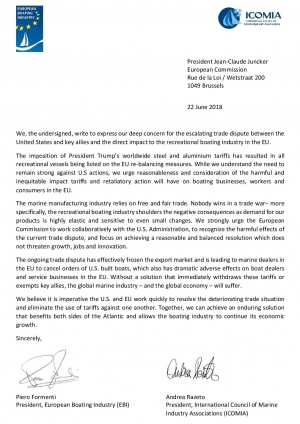
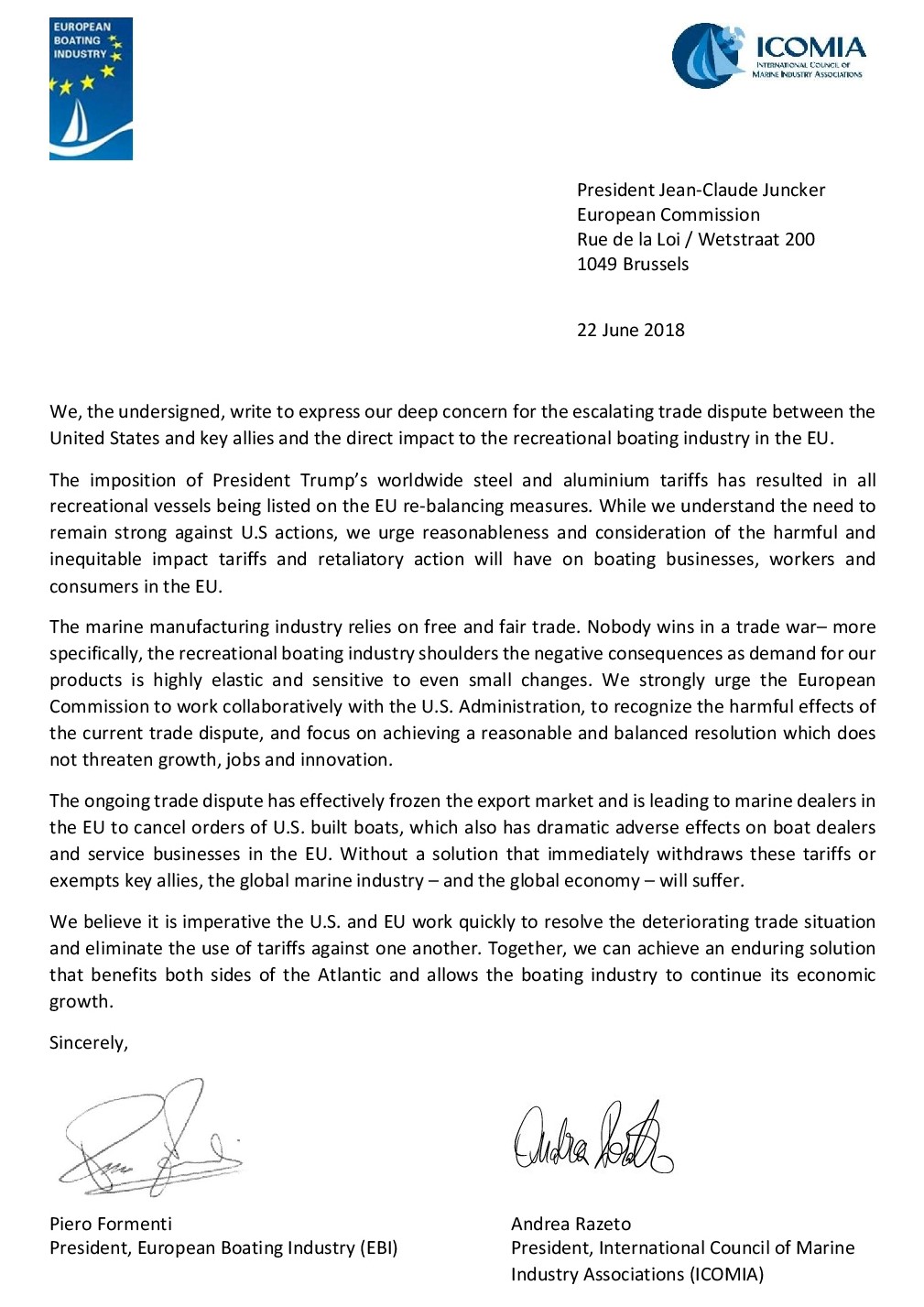
The rebalancing measures adopted by the European Commission to counterbalance the tariffs on steel and aluminium imposed by the US entered into force on 22 June.
The additional ad valorem duties on imports of the products listed in Annex I, apply from the date of entry into force of this Regulation and until the United States ceases to apply its safeguard measures to products from the Union.
EBI and ICOMIA have sent a joint letter to President of the European Commission, Jean-Claude Juncker.
EBI is working together with NMMA and ICOMIA, asking a de-escalation of the trade war to the US administration and to the European institutions.
 Guide to application of Directive 2013/53/EU on the harmonisation of the law of the Member States relating to recreational craft and personal watercraft
The European Commission published the new application guide revised from June 2018, that was approved by the last Recreational Craft Directive Working Group meeting on 11 June.
The Application Guide to the Recreational Craft Directive 2013/53/EU provides guidance on the application of the essential health and safety requirements.
The guide will be regularly updated by the Working Group, of which EBI is a member.
Download the RCD 2013/EU guidelines
! Be aware that it is a guidance document which does not have legal force.
The European Commission published several Declarations of Conformity (DoC)
- DoC template for components - EU Declaration of Conformity for Design and Construction for Watercraft Components
- DoC for PCA for components - EU Declaration of Conformity for Post-Construction Assessment (PCA) for Design and Construction for Watercraft’s Components
- DoC for PCA for inboard & outboard engines - EU Declaration of Conformity for Post-Construction Assessment (PCA) propulsion engines
- DoC for PCA for personal watercraft - EU Declaration of Conformity Post-Construction Assessment (PCA) of Personal Watercraft
- DoC for PCA for recreational craft - EU Declaration of Conformity Post-Construction Assessment (PCA) of Recreational Craft
 Best practices and user stories
Prepared by the Directorate-General for Maritime Affairs and Fisheries (European Commission) in April 2018
This compendium regroups initiatives in Europe that help developing the skills of maritime professionals and making them fit for the diverse needs of an evolving maritime economy. More particularly, the initiatives focus on digitalization and globalization and the new opportunities and unforeseen challenges this technology brought upon the sector.
 Best practices and user stories - Study
Prepared by the Directorate-General for Maritime Affairs and Fisheries (European Commission) in April 2018
This compendium regroups initiatives in Europe that help developing the skills of maritime professionals and making them fit for the diverse needs of an evolving maritime economy. More particularlyd, the intiatives have the objective to increase ocean knowledge.
 Best practices and user stories - Study
Prepared by the Directorate-General for Maritime Affairs and Fisheries (European Commission) in April 2018
This compendium regroups initiatives in Europe that help developing the skills of maritime professionals and making them fit for the diverse needs of an evolving maritime economy. More particularly, it looks at the link between education and industry in the maritime economy, sectors in constant evolution.
 Prepared for the European Commission, in November 2016
After the Communication from the European Commission, A European Strategy for more Growth and Jobs in Coastal and Maritime Tourism, that underlined the importance of coastal and maritime tourism, especially for employment for the whole economy, the Directorate General Entreprise and Industry ordered this study to assess the overall competitiveness of the recreational boating sector.
The study identifies the main factors influencing the competitive performance of the EU recreational boating industry and provides policy recommendations on how the competitiveness of this sector in Europe could be improved. Several aspects are researched:
- Analysis of the demand for recreational boating in Europe
- Analysis of the boat manufacturing sector
- Analysis of the services sector
- Scenarios and recommendations to improve the EU’s growth and employment strategy
 Also known as Marine Strategy Framework Directive (MSFD)
What is the aim of the directive?
- It establishes a common approach and objectives for the prevention, protection and conservation of the marine environment against damaging human activities
- It requires EU countries to develop strategies to achieve ‘good environmental status’ by 2020
- It emphasises the need for EU countries to cooperate with their neighbours in the marine regions
- It recognises the importance of spatial protection measures for the marine environment
 Published in October 2015
The Marine Strategy Framework Directive requires Member States to adopt Programmes of Measures to achieve good environmental status in their marine waters by 2020.
The Programmes of Measures shall include spatial protection measures contributing to coherent and representative networks of marine protected areas (MPAs). This is the report on the progress in establishing marine protected areas
 Commissioned by the European Confederation of Nautical Industries, ECNI. June 2009
This study is structured in order to follow the life-cycle approach of a boat, and identify its environmental impact from its conception and manufacturing stage, through its useful life and related operations, and concluding with its disposal at the end of life of the boat.
 Communication published in February 2014
Following the Commission's 2010 Communication announcing a strategy for sustainable coastaland maritime tourism, this Communication from 2014 proposes joint responses to the multiple challenges, with a view to capitalise on Europe's strengths and enabling it to substantially contribute to the Europe 2020 objectives for smart, sustainable and inclusive growth.
 English
 Български
 Hrvatski
 Čeština
 Dansk
Dansk Nederlands
 Eesti
Eesti Suomi
Suomi Français
 Deutsch
 Ελληνικά
 Magyar
 Gaelige
 Italiano
 Latviešu valoda
 Lietuvių kalba
 Maltese
 Norsk bokmål
 Polski
 Português
 Română
 Русский
 Slovenščina
 Español
 Svenska