

- Home

- Newsroom
- Press releases
- Super User

Super User
The European Commission published the European Green Deal, which is the flagship initiative of the European Commission to tackle climate change and environmental challenges. It is a roadmap to make EU's economy sustainable and addressing climate and environmental challenges.
The European Green Deal provides a roadmap with actions to boost the efficient use of resources by moving to a clean, circular economy and stop climate change, revert biodiversity loss and cut pollution. It also sets out the investments needed, as well as the tools to ensure a just and inclusive transition. It includes the outline of the future European Climate law, which will enshrine the ambition of being the world's first climate neutral continent by 2050. Other elements of the European Green Deal will also be presented by the Commission in the near future, such as the Biodiversity Strategy for 2030, the new Industrial Strategy and Circular Economy Action Plan and proposals for pollution-free Europe.
While the exact impact and relevance for the recreational boating industry will become clearer in the coming months, some elements are foreseen that may be relevant
- New EU strategy on adaptation to climate change, such as climate-proofing, building resilience and preparedness
- Increasing uptake of the circular economy across sectors through circular design and increased use of recycled materials
- Commercial application of new clean technologies, such as hydrogen, fuel cells and other alternative fuels
- Promotion of inland waterways as means of transport
- Increased engagement with the International Maritime Organisation (IMO) on climate change and environmental protection
- Increasing coverage of sea areas by Natura 2000 network and support for more connected and well-managed marine protected areas (MPAs)
- Support for a sustainable blue economy
- Zero-pollution approach across all policy areasNew chemicals strategy aiming at sustainability, with protection against hazardous chemicals and promotion of alternatives
- Financing through Sustainable European Investment Plan for additional funding needs
EBI will be engaging with the EU institutions to provide input to the actions laid out in the European Green Deal as a partner in tackling climate change and as a beneficiary of a clean environment and healthy oceans. The full European Green Deal can be found here.
A presentation of the European Green Deal from the European Commission will also take place at the International Breakfast Meeting (IBM) at boot Düsseldorf on 21 January. More information can be found here.
The European Environment Agency (EEA) released Europe’s state of the environment report for 2020. This is published by the EEA every five years since 1995 and is now in its 6th edition. The EEA is an official EU agency that provides independent information on the environment.
The 2020 report comes to the conclusion that European environment and climate policies have helped to improve the environment over recent decades, but progress is insufficient and the outlook for the environment in the coming decade is not positive. It analysed the achievement of meeting 2020 and 2030 policy targets, as well as longer term 2050 goals.
The report notes that Europe has already made significant progress over the past two decades in terms of climate change mitigation and reducing greenhouse gas emissions. Signs of progress are also evident in other areas, such as tackling air and water pollution and the introduction of new policies to tackle plastic waste and bolster climate change adaptation and the circular and bio-economy.
Overall environmental trends in Europe have however not improved since the last EEA state of the environment report in 2015. The assessment notes that while most of the 2020 targets will not be achieved, especially those on biodiversity, there is still a chance to meet the longer-term goals and objectives for 2030 and 2050. Recent trends highlight a slowing down of progress in areas such as reducing greenhouse gas emissions, industrial emissions, waste generation, improving energy efficiency and the share of renewable energy. It concludes that the current rate of progress will not be enough to meet 2030 and 2050 climate and energy targets.
The report outlines seven key areas where bold action is needed to get Europe back on track to achieve its 2030 and 2050 goals and ambitions. These are:
- Realise potential of existing environmental policies through full implementation
- Embrace sustainability as the framework for policy making with binding targets
- Lead international action towards sustainability by using the EU’s diplomatic and economic influence to promote the adoption of ambitious international agreements
- Foster innovation throughout society
- Scale up investments and refocus the finance sector on sustainable projects and businesses
- Manage risks and ensure a socially fair transition to ensure sure no one is left behind
- Build more knowledge and know-how.
The full report can be found here, as well as the Executive Summary here.
A European Commission fitness check of the Water Framework Directive, the Floods Directive and the associated Directives concluded that they are fit for purpose with room for enhanced effectiveness. This means that no legislative changes are recommended, but focus will be on implementation. Despite improvements in the protection of water bodies, the evaluation points to insufficient level of implementation by Member States and by sectors with a heavy impact on water.
The results of the evaluation of the Water Framework Directive are mixed. On the one hand, it has been successful in setting up a governance framework for water management for water bodies in the EU, slowing down the deterioration of water status and reducing chemical pollution. On the other hand, implementation of the Directive has been significantly delayed. As a result, less than half of the EU’s water bodies are in good status, even though the deadline for achieving this was 2015.
The fact that the Directive’s objectives have not been fully reached is largely due to insufficient funding, slow implementation and insufficient integration of environmental objectives in sectoral policies, rather than deficiencies in the legislation. The insufficient level of implementation by Member States and by those sectors of the economy with an impact on water has come to the forefront across the evaluation and all Directives.
The fitness check also concluded that the Water Framework Directive is sufficiently flexible to accommodate emerging challenges such as climate change, water scarcity and pollutants of emerging concern (e.g. micro-plastics and pharmaceuticals). Chemicals is a key area where there is room to improve and to achieve better results.
The full fitness check can be found here and the Executive Summary here.
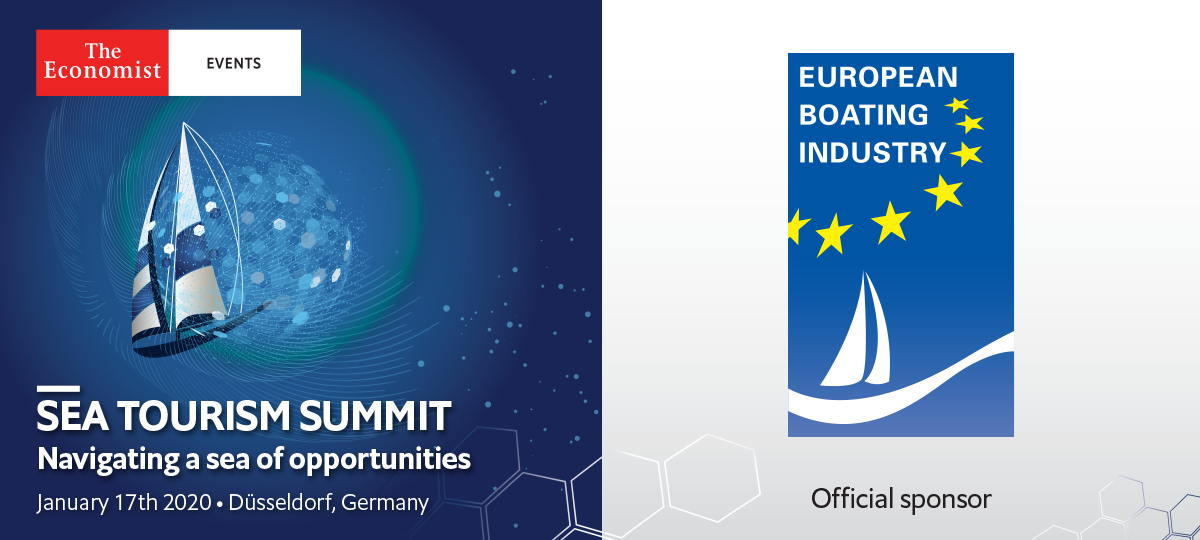 boot Düsseldorf will be hosting the “Sea Tourism Summit: Navigating a sea of opportunities” event. It will take place on Friday, 17 January 2020 and will cumulate in a celebratory gala dinner where former Italian Prime Minister Matteo Renzi will give the keynote speech. Eminent leaders from politics, business, the EU and international institutions will participate in this dialogue on maritime tourism.
More information and tickets here.
 Speakers have been announced for the 2020 edition of the International Breakfast Meeting (IBM) featuring the topic of sustainable boating. They include the European Commission, as well as innovators and entrepreneurs from the fields of hydrogen, digitalisation, electric and hybrid. IBM is organised by boot Düsseldorf, the world’s largest boat show and EBI, the voice of Europe’s recreational boating industry.
Growing to over 150 participants in 2019, the conference will provide high-level discussions and thought leadership on the issue of decarbonisation. IBM 2020 takes take place on Tuesday, 21 January 2020 from 8:30 until 10:30 in the Congress Center East at boot Düsseldorf.
The following speakers have been confirmed
- Petros Michelidakis (Director, boot Düsseldorf)
- Robert Marx (President, boot Düsseldorf & President BVWW)
- Jean-Pierre Goudant (President, European Boating Industry)
- Dr. Artur Runge-Metzger (Director, European Commission Directorate-General for Climate Action)
- Representative of the Energy Observer team
- Vladimir Zinchenko (CEO, Greenline Yachts)
- Marteen Bernhart (Founder, La Bella Verde)
- Simon Bühl (Founder & CEO, BrandUp Factory)
- Philip Easthill (Secretary General, European Boating Industry)
To register free-of-charge, please click here (and to register in German here). For more information about the IBM, please click here.
The policy paper sets forward a list of objectives and actions for promoting Blue Economy in the Mediterranean based  on the technical and policy results of the Blue Growth Community projects. One of its focal sectors is the yachting industry for which specific recommendations were developed.
Sea tourism has always been a significant part of the tourism industry as well as an engine of growth, innovation and extroversion for the coastal countries. Certain aspects of globalisation, such as the liberalisation of transport and communication along with the digital revolution and the increased interest in travelling abroad have favoured the sector, resulting in new, innovative services and infrastructures. On the other side, the aftermath of the last global recession, fears of a new recession, tight government budgets and the ageing of population have raised new concerns and challenges. In times of environmental crisis, the sustainability issue is of critical importance; enhancing environmental awareness is not just a necessity but also an opportunity.
Within this context, The Economist’s Sea Tourism Summit entitled “Navigating a sea of opportunities” is organised on 17th January in Düsseldorf. Distinguished leaders from government, politics and business, as well as prominent officials from the EU and the international institutions will take part in this stimulating dialogue covering a wide range of issues related to sea tourism.
EBI is a proud sponsor of The Economist’s Sea Tourism Summit. More information and registration here.

Speakers have been announced for the 2020 edition of the International Breakfast Meeting (IBM) featuring the topic of sustainable boating. They include the European Commission, as well as innovators and entrepreneurs from the fields of hydrogen, digitalisation, electric and hybrid. IBM is organised by boot Düsseldorf, the world’s largest boat show and EBI, the voice of Europe’s recreational boating industry.
Growing to over 150 participants in 2019, the conference will provide high-level discussions and thought leadership on the issue of decarbonisation. IBM 2020 takes take place on Tuesday, 21 January 2020 from 8:30 until 10:30 in the Congress Center East at boot Düsseldorf.
The following speakers have been confirmed
- Petros Michelidakis (Director, boot Düsseldorf)
- Robert Marx (President, boot Düsseldorf & President BVWW)
- Jean-Pierre Goudant (President, European Boating Industry)
- Dr. Artur Runge-Metzger (Director, European Commission Directorate-General for Climate Action)
- Representative of the Energy Observer team
- Vladimir Zinchenko (CEO, Greenline Yachts)
- Marteen Bernhart (Founder, La Bella Verde)
- Simon Bühl (Founder & CEO, BrandUp Factory)
- Philip Easthill (Secretary General, European Boating Industry)
To register free-of-charge, please click here (and to register in German here). For more information about the IBM, please click here.
As part of the European Commission’s BlueInvest Platform, the Readiness Assistance offers a coaching programme for high potential start-ups and SMEs with innovative and sustainable products and solutions for the Blue Economy. Businesses and projects selected for Investment Readiness Assistance will receive coaching packages tailored specifically to their readiness levels and business objectives. The programme has a clear focus on providing business support to help start-ups and SMEs build capacities for growth and attract investment. Up to 200 businesses will be selected to receive coaching tailored specifically to their business objectives. Each participant will be matched with a dedicated business coach, whom they will work with to develop a set of concrete business objectives. Participants will receive targeted assistance from their business coach, who will work with them to achieve their set objectives within a defined timeframe. The one-to-one coaching sessions will be conducted over a 3-month period, both in-person as well as digitally.
Participants will also benefit from additional training through participant-only sessions organised at the BlueInvest Academy, networking and B2B matchmaking sessions at the BlueInvest events. A competitive selection process will be used to select the best candidates for the BlueInvest Readiness Assistance.
For more information and the application form, please click here.
Deadline: 27 February 2020
Through the European Maritime and Fisheries Fund (EMFF), the European Commission is providing grants to market- and investment-ready SMEs with innovative products, technologies and services for the blue economy.
The 2019 call is open until 27 February 2020. It has an available budget of EUR 22.5 million. Organisations can get between €700,000 and €2,500,000 for their projects. Any for-profit SME based in the EU can apply, either as a single participant or a member of a consortium. EBI is available to support interested EBI member companies in the process.
For further information and how to apply, please click here.

 English
 Български
 Hrvatski
 Čeština
 Dansk
Dansk Nederlands
 Eesti
Eesti Suomi
Suomi Français
 Deutsch
 Ελληνικά
 Magyar
 Gaelige
 Italiano
 Latviešu valoda
 Lietuvių kalba
 Maltese
 Norsk bokmål
 Polski
 Português
 Română
 Русский
 Slovenščina
 Español
 Svenska