

- Home

- Newsroom
- Press releases
- Super User

Super User
 EBI is aiming to inform the recreational boating industry about the developments regarding the measures to tackle the COVID-19 outbreak at EU level, as well as its advocacy activities. All information is updated regularly (highlighted in green) and provided freely. EBI is fully available to support and all contact can be directed to the Secretary General (pe(a)europeanboatingindustry.eu). For national support measures, we advise you to contact national associations.
1. Industry position & Advocacy
EBI position paper with recommendations on EU and national COVID-19 recovery plans (15 June 2020)
EBI on behalf of the European recreational boating industry welcomed the EU Recovery Plan. In its position paper reacting to the proposal, EBI calls for national and EU investment programmes to incorporate the particularities of the boating and nautical tourism industry and ensure that investment is provided for a green and digital transition. This can also allow nautical tourism to play a strong role in developing a more sustainable tourism and strengthen European regions long-term. The full press release can be found here and the position paper here.
EBI participation in strategic dialogue with Commissioner Thierry Breton (28 May 2020)
European Boating Industry (EBI) joined a strategic dialogue with EU Commissioner for Industry and Internal Market Thierry Breton on the recovery of the maritime sector following COVID-19. EBI presented the impacts of COVID-19 on the recreational boating industry and the opportunities to lift the sector from the crisis through measures at EU level. The other maritime sector stakeholders represented were ship builders, maritime equipment producers and ship owners. For more information, click here.
European Tourism Manifesto alliance statement on EU Tourism Package (20 May 2020)
The European Tourism Manifesto alliance, the voice of the European travel and tourism sector of which EBI is a member, has issued a statement on the European Commission’s Tourism package. It highlights that the package represents a first and important step to facilitate travel and tourism in Europe, support the sector’s recovery from the crisis and enable a more sustainable tourism ecosystem in the future. It calls for a swift implementation and further measures to ensure that the tourism industry can restart and recover. The full statement can be found here.
Joint policy paper by European boating industry associations to address COVID-19 outbreak (9 April 2020)
The policy paper, signed by 20 associations, calls on the EU institutions and national governments to support the sector and protect jobs against the impact of the COVID-19 outbreak. It calls for swift measures to help companies survive the immediate crisis and actions to support recovery and stimulate demand.
The full paper can be found here.
European tourism sector demands urgent supportive measures to reduce devastating impact of COVID-19 (17 March 2020)
The European Tourism Manifesto alliance, the voice of the European travel and tourism sector issued a statement on the need for urgent measures to limit the COVID-19 outbreak’s impact. EBI is a member of the coalition and fully supports the statement.
The full statement can be found here.
2. Preparedness and exit measures
European Commission preparation for preparedness for COVID-19 outbreaks (15 July 2020)
The European Commission has published short-term measures to strengthen EU health preparedness for COVID-19 outbreaks. This should lead to fast response from the Commission and the Member States to contain the spread of the virus and new, generalised lockdowns can be avoided.
The Communication focuses on all necessary actions needed to enhance preparedness, including testing and contact tracing, improved public health surveillance and widened access to medical countermeasures such as personal protective equipment, medicines and medical devices. It highlights that temporary controls at borders should only be used in exceptional circumstances as a last resort measure. The Commission also underlines the need to avoid large-scale lockdown measures in case of further outbreaks and to address impact of different sectors, such as tourism. More information can be found here.
EU roadmap for lifting of COVID-19 containment measures (15 April 2020)
The European Commission presented the roadmap for lifting containment measures at national level. It aims to coordinate the lifting and develop a coherent approach at European level, also to support re-establishment of supply chains and recovery.
The Commission’s roadmap lays out three principles to the lifting of measures: 1) a science-based approach, 2) Coordination between Member States and 3) respect and solidarity between Member States. Member States should notify each other and the Commission before taking measures and adapt accordingly. The Commission issued specific recommendations to Member States on how to lift containment measures.
Member States are not obliged to follow the roadmap but have agreed on the necessity to coordinate and are expected to follow the recommendations. The full roadmap can be found here. For an overview of current restriction measures at national level, please click here.
3. Economic and fiscal measures
Presentation of €750 billion EU recovery plan (27 May 2020)
The Commission unveiled the long-awaited EU recovery plan called Next Generation EU with an unprecedented €750 billion recovery fund. Tourism and recreation are mentioned as the sectors most affected in terms of turnover decrease, loss of value added and companies at risk of default.
A mixture of mostly grants and loans will be available for EU countries to finance their recovery under the €560 billion Recovery and Resilience Facility. EU countries will have to present national recovery plans. New cohesion funding of €55 billion will be available to EU countries distributed according to impact on hard-hit sectors, including tourism and provide support for these sectors. In addition, a new €31 billion Solvency Support Instrument to support otherwise healthy companies affected by COVID-19 impact will be implemented by providing partial guarantees against losses. InvestEU, the EU’s investment programme will also provide €15.3 billion to mobilise private investment in projects and the European Maritime and Fisheries Fund will be increased by €500 million. The Commission identified 14 industrial ecosystems that should be prioritised with the boating industry considered to falling under two of them: Tourism and Mobility-Transport-Automotive. For the tourism ecosystem the basic investment need is seen as highest with €161 billion and for Mobility-Transport-Automotive €64 billion. Throughout the recovery plans, the focus is on the green and digital transformation. The next steps will be for the national leaders in the EU Council to reach a political agreement on the the overall funding and structure by July. For more information, click here.
Council adopts SURE instrument as temporary support for short-time work schemes (19 May 2020)
The Council of the EU (in which EU countries are represented) adopted SURE, a temporary scheme which can provide up to €100 billion of loans under favourable terms to EU countries. The instrument enables countries to request EU financial support to help finance national short-time work schemes and similar measures. It is one of the three safety nets, worth €540 billion, for jobs and workers, businesses and member states at EU level. Financial support to Member States will become available once Member States have committed and signed their guarantee agreements with the Commission. More information can be found here.
Agreement on €540 bn package of economic support measures (9 April 2020)
The EU finance ministers agreed on a package of economic support measure for Member States to tackle the COVID-19 outbreak. It allows the European Investment Bank to set up a fund of €200 billion in loans for companies. The European Commission’s proposal of a €100 bn instrument to support national short-time work schemes was also supported. Lastly, any Eurozone country will also be able to draw on a credit line worth 2 percent of its economic output from the eurozone’s bailout fund (the European Stability Mechanism) The funds can be used without conditions but must be used to finance direct or indirect healthcare, or cure and prevention related costs. The credit line will be available until the end of the crisis. This €240 billion in credit lines should be accessible within two weeks. The so-called Coronabonds are not part of the package agreed but may be discussed again at a later stage.
Ministers also agreed on working on a Recovery Fund to prepare and support the recovery, providing funding through the EU budget to programmes designed to kick-start the economy. This still requires discussion on financing and structure. They also announced ongoing work on a broader Roadmap and Action Plan for Recovery.
The full package will next be discussed by the European Council of national leaders. The full statement can be found here.
European Investment Fund support of €8bn for SMEs (6 April 2020)
Through EU funding, the European Investment Fund will provide funding to banks and other lenders. These will then provide liquidity to at least 100,000 European SMEs and small mid-cap companies hit by the economic impact of the COVID-19 outbreak. An estimated financing of €8 billion will be available towards the end of April. SMEs will be able to apply directly to their local banks and lenders participating in the scheme. These will be listed on www.access2finance.eu in the next weeks.
Coronavirus Response Investment Initiative (26 March 2020)
The Commission has published the “Coronavirus Response Investment Initiative” (CRII) with €37 billion to the COVID-19 outbreak. This will provide funds to Member States in order to tackle short-term financial shocks, with special attention on sectors which are particularly hard hit (including tourism). A Task Force has been set up to coordinate precise needs with Member States and assist them to ensure that money starts flowing as soon as possible. This proposal was approved by the Council and the European Parliament.
The full information can be found here.
Temporary Framework for State Aid (19 March 2020)
The Commission has adopted a Temporary Framework to enable Member States to support the economy in the context of the Coronavirus outbreak. The Temporary Framework provides for five types of aid, which can be granted by Member States: 1) direct grants, selective tax advantages and advance payments, 2) state guarantees for loans taken by companies from banks, 3) subsidised public loans to companies, 4) safeguards for banks that channel state aid to the real economy and 5) short-term export credit insurance.
All state aid decisions taken under the temporary framework can be found here.
4. Measures for the tourism & maritime industry
European Parliament proposes further measures to save EU tourism industry (19 June 2020)
In a joint resolution, approved by the majority of MEPs, the European Parliament calls for additional measures to save the EU’s tourism and travel sector and make it future-proof.
In the short-term, the focus should be on short-term financing to avoid companies from going bankrupt. For long-term recovery and modernisation of the sector, the Parliament requests the Commission to issue guidance to ensure available funding can be accessed swiftly and implement a dedicated budget line for sustainable tourism in the EU’s long-term budget. The Parliament also stresses the importance of developing a coastal and maritime focus in the EU tourism strategy and specific financing and promotion initiatives in cooperation with stakeholders and authorities.
The Parliament also calls for the establishment of common standards and detailed protocols for hygiene and health screening, an early alert system that warns tourists about potential health threats at their destination and the creation of an EU hygiene and safety certificate. It also asks the Commission to launch a dedicated information campaign on travel and tourism and ensure safe travel across borders without unilateral measures and agreements between individual member states. MEPs see the crisis also as an opportunity to modernise the EU tourism industry and make it more environmentally friendly, socially responsible and economically sound.
The full motion for resolution can be found here.
Re-open EU map launched with travel and tourism information for EU countries (15 June 2020)
The European Commission released the “Re-open EU” map that provides real-time information on EU internal borders, tourism services and health information. It can be found under the following link with information for all EU countries in all official languages: reopen.europa.eu. The aim is to support the summer tourism season by providing travellers with relevant information. Nautical tourism activities (marinas, water sports and boat charter/hire) are covered under the heading “beaches and tourist areas”.
Transport and Tourism Committee hearing on Commission tourism package (29 May 2020)
At the hearing of the Transport and Tourism Committee, the European Commission presented its package of guidelines and measures to support the tourism industry. Overall, MEPs supported the Commission’s approach but insisted on more concrete actions and financial support ahead of the summer season.
On rebooting tourism, MEPs underlined the need to restore trust in safe travelling through additional measures. The Commission announced that a website on tourism and borders will be available in a few weeks. Many MEPs raised the issue of job losses, risk of bankruptcies in the sector, and mentioned the lack of concrete help and short-term financial support as well as the need for a dedicated long-term budget line. The Commission highlighted that cooperation between EU countries has improved. Lifting travel restrictions, including opening borders, should be based on set criteria and strong health protocols. The Commission is encouraging EU countries to introduce certification schemes for safe travelling. A similar EU-level action, however, will not be feasible ahead of this summer.
On the issues of vouchers as alternatives to reimbursement, MEPs highlighted that the rules for reimbursements are not being followed by some EU countries. The Commission assured MEPs that they are following the issue and the right to a cash reimbursement is retained.
Meeting of EU Tourism Ministers on COVID-19 (20 May 2020)
Tourism ministers of EU countries welcomed the Commission Tourism Package and guidelines. They expressed strong support for a number of principles to guide reopening of travel and tourism: close coordination at EU level, a step-by-step approach, decisions based on sound epidemiological data, and non-discrimination. Ministers encouraged the Commission to carry out its plans to create an interactive website with real-time information on the conditions and measures in place in each EU country concerning tourism. Several EU countries were of the view that the tourism sector needs swift and targeted financial support at EU level to address the impact of the COVID-19 crisis, including from the upcoming EU industrial recovery plan. Regarding passengers whose flights were cancelled due to the pandemic, several ministers called upon the Commission to provide EU countries with additional flexibility to address liquidity problems of airline companies.
Publication of EU Tourism package (13 May 2020)
The European Commission presented a package of guidelines and recommendations to gradually open borders and allow tourism businesses to restart while respecting health and safety measures. It encourages consumers to take advantage of the summer tourism season and help the EU tourism sector recover. It includes an overall strategy towards recovery in 2020 and beyond, a gradual lifting of border restrictions, re-establishment of transport links, criteria for restoring tourism activities and health protocols, as well as a recommendation on vouchers as alternatives to reimbursement. These guidelines and recommendations are provided to EU countries and companies for implementation.
Throughout these measures, the Commission recognises the importance of on-water recreation, and the maritime and inland waterway tourism industry. At several points, it highlights that leisure boating should not fall under a general prohibition but be allowed following a risk-based approach and implementing specific procedures, such as regular cleaning and disinfection. EU countries should lift restrictions for leisure boating based on specific health and safety protocols. The Commission specifically mentions marinas and resuming activity in these under strict health and safety conditions. The Commission recognises that domestic and intra-EU tourism will be increasingly popular and should be promoted. It sees a strong role for maritime and inland waterway tourism in this.
The full information on the Tourism Package can be found on the website of the European Commission here. EBI’s press release on the publication can be found here.
Meeting of EU Tourism Ministers for discussion of tourism restart and recovery (27 April 2020)
EU Tourism Ministers met by videoconference to discuss the impact of COVID-19 on the tourism industry and how the sector can be safely re-started. The idea of opening ‘tourist corridors’ between EU member states was discussed, as well as need for strong support for tourism in the EU Recovery Plan and consistent rules for both air and sea or land mobility. Many ministers raised the high impact of tourism on economies and connected sectors. There was broad support for additional measures and enhanced coordination at EU level. Ministers highlighted the importance of a harmonised solution for travel and tourism, including vouchers where the Commission was invited to work towards a common EU approach. Internal Market Commissioner Thierry Breton participated in the meeting and underlined the need for a coordinated approach. Besides other support measures, he also announced that the Commission will propose protocols to guide safe operation of tourism facilities across the EU. His full speech can be found here.
In advance of the meeting, a group of nine Tourism Ministers signed a declaration on the need to prioritise the tourism industry in the current situation (Bulgaria, Cyprus, France, Greece, Malta, Italy, Portugal, Romania and Spain). The letter can be found in full here.
Call for support to maritime sector from European Parliament Intergroup (21 April 2020)
The Intergroup of the European Parliament dealing with Seas, Rivers, Islands and Coastal Areas (SEARICA) issued a declaration to support the maritime sector in tackling the impact of COVID-19. It calls to defend the maritime sector and for urgent action in terms of economic recovery action plans at EU and all levels. It recognises the impact on ports, waterways, coastal and maritime tourism, shipbuilding, and maritime equipment production. The paper was signed by Chair of the Intergroup MEP Tonino Picula and the board of twelve Vice-Chairs.
The full declaration can be found here.
Statement by European Commission on cancellation of package travel holidays due to COVID-19 (9 April 2020)
Commissioner for Justice Didier Reynders repeated his call to Member States and travel organisers to find pragmatic and flexible solutions that respect travellers’ rights for cancelled package travel holidays concerning the COVID-19 outbreak. While he underlined the traveller’s right to be reimbursed in accordance with the EU Package Travel Directive, he called for pragmatic solutions to be found:
“Travellers have the right to get a full refund if their trip is cancelled. However, when possible, consumers should consider accepting a voucher that allows them to postpone their holidays to a later point in time, under certain conditions. Such voucher should be reimbursable if not used and secured against possible insolvency of the operator. At the same time, Member States should also consider providing liquidity support to the travel business that allows them to settle travellers’ refund claims, in accordance with State aid rules.”
The Commission specifically refers to the Danish State loan facility in support of the Travel Guarantee Fund as best practice in this regard (see here). Last month, the European Commission published an advisory guidance on EU package travel rules in the context of COVID-19 (see below).
The full statement can be found here. The non-binding guidance that the Commissions issued on this topic on 19 March can be found here.
5. Travel restrictions & border closures
Travel restrictions to the EU
The temporary restrictions on non-essential travel to the EU are reviewed and pdated every two weeks by the Council of the EU. It updates the list of countries for which travel restrictions should be lifted. Based on the criteria and conditions set out EU countries should gradually lift the travel restrictions at the external borders for residents of certain third countries. The latest list of countries can be found here.
Commission recommends lifting of internal EU borders by 15 June and starting to lift travel restrictions to EU from 1 July (11 June 2020)
The Commission recommends to Schengen countries and associated states to lift internal border controls by 15 June 2020.
The temporary restriction on non-essential travel into the EU should be prolonged until 30 June 2020 but be gradually lifted afterwards. The Commission does not propose a general lifting of the travel restrictions to the EU. It should only be lifted for countries selected together with EU countries based on objective criteria including the health situation, the ability to apply containment measures during travel, and reciprocity considerations. It will be based on information from the WHO and European Centre for Disease Control (ECDC). A common list of non-EU countries for which travel restrictions can be lifted from 1 July will be drawn up and reviewed on a regular basis. The Commission also recommends lifting travel restrictions for Albania, Bosnia and Herzegovina, Kosovo, Montenegro, North Macedonia and Serbia as of 1 July, given that their health situation is similar or better than that of the EU.
Extension of restriction on non-essential travel to the EU until 15 June (11 May 2020)
The Commission recommended to again extend the temporary restriction on non-essential travel to the EU until 15 June. It sees this as necessary to reduce the risk of COVID-19 spreading further. The travel restriction, as well as the invitation to extend it, applies to the ‘EU+ area', which includes all Schengen Member States (including Bulgaria, Croatia, Cyprus, and Romania) and the 4 Schengen Associated States (Iceland, Liechtenstein, Norway, and Switzerland). Any further extension of the travel restriction beyond 15 June will be assessed again, depending on the evolution of the COVID-19 outbreak. The travel restriction does not apply to EU citizens, citizens of non-EU Schengen countries and their family members, and non-EU nationals who are long-term residents in the EU when returning home. The full communication can be found here.
European Parliament letter to Commission on nautical products in the Single Market (28 April 2020)
A group of fourteen Members of the European Parliament from several political groups and countries co-signed a letter to Internal Market Commissioner Thierry Breton. It addresses one of the key problems for the boating industry from the COVID-19 outbreak, which are supply chain and boat delivery issues due to border closures and national policies. The letter underlines the impact of COVID-19 on the sector and the need to allow boat deliveries by all suitable means without undue restrictions. The full letter and its signatories can be found here.
Guidance on free movement of workers during COVID-19 (30 March 2020)
The Commission has issued guidance on mobile workers within the EU to allow then to reach their workplace. This focusses on people in critical professions to tackle the COVID-19 outbreak, but also applies for all other professions that workers have to reach across borders. The Commission underlined that despite the recently introduced border controls it is imperative that critical workers are able to reach their destination without delay. The full list of critical occupations can be found in the guidelines. The guidelines also clarify that Member States should allow frontier workers in general to continue crossing borders if work in the sector concerned is still allowed in the host Member State. Member States should treat cross border workers and national workers in the same manner.
The Commission urges Member States to establish specific burden-free and fast procedures for border crossings with a regular flow of frontier and posted workers, to ensure a smooth passage for them. This may be done, for instance, by means of dedicated lanes at the border for such workers or with specific stickers recognised by neighbouring Member States to facilitate access to the territory of the Member State of employment.
The full guidance can be found here.
EU border restrictions and introduction of ‘green lanes’ for goods (23 March 2020)
To alleviate the potential negative impact of border closures on transport of goods, the Commission proposed guidelines to secure the flow of goods on 16 March. This included the designation of priority lanes for freight transport (so-called green lanes). The full guidelines can be found here.
These were now further specified by the Commission and supplemented with practical advice. The full information can be found here. All major border crossings in the trans-European transport network should be designates as ‘green lane’ border crossings according to the Commission (see here for the map).
Below are some key measures that should be applied at these crossings:
- Procedures should be minimised and streamlined to what is strictly necessary, and should not take more than 15 minutes on land borders for any type of good
- Checks and screening should be carried out without drivers having to leave their vehicles, and drivers should undergo only minimal checks
- Drivers of freight vehicles should not be asked to produce any document other than their identification and driving license and if necessary, a letter from the employer
- Electronic submission/display of documents should be accepted
- No freight vehicle or driver should face discrimination, irrespective of origin and destination, the driver's nationality or the vehicle's country of registration
- Member States should temporarily suspend all types of road access restrictions in place in their territory (weekend bans, night bans, sectoral bans, etc.)
The Commission also includes recommendations for drivers and relevant transport-related undertakings (loading, unloading, rest times, border crossings). Companies should inform EBI about issues encountered with supply chains and transport across borders. These will be raised towards the European Commission.
6. Production of Personal Protective Equipment
Guidance on production of protective equipment for prospective manufacturers (30 March 2020)
Several companies in the boating industry have changed their production towards protective equipment. The European Commission has now issued guidance for such companies to understand and assess the applicable legal and technical requirements. This can be found below
- Conformity assessment procedures for protective equipment (e.g. face masks) - here
- Conformity assessment procedures for 3D printing and 3D printed products to be used in a medical context for COVID-19 - here
- Guidance on the applicable legislation for leave-on hand cleaners and hand disinfectants - here
This comes in addition to the European standardisation committees (CEN and CENELEC), making European standards for certain medical devices and personal protective equipment freely available. This helps companies willing to manufacture these items to swiftly start production. The standards can be found here.
7. Economic forecasts
European Travel Commission releases long-haul travel barometer (11 June 2020)
The results of the latest Long-Haul Travel Barometer (LHTB), released by the European Travel Commission, indicate that confidence for travel to Europe in summer 2020 is weak across all six markets monitored. However, citizens in some markets are interested in resuming travel. The full report can be found here.
European Commission Spring Economic Forecast (6 May 2020)
The European Commission published its Spring economic forecast, the first one to fully consider the impact of COVID-19. It provides a forecast at European level, EU Member States, candidate countries and certain other non-EU Countries. The impact of COVID-19 will affect all countries, even if at different levels. The same is the case for the speed of the recovery expected in 2021.
- The Euro area economy will contract by 7.75% in 2020 and grow by 6,25% in 2021. The EU economy is forecast to contract by 7.5% in 2020 and grow by around 6% in 2021.
- The unemployment rate in the Euro area will rise from 7.5% in 2019 to 9.5% in 2020 before reducing to 8.5% in 2021. In the EU, it will rise from 6.7% in 2019 to 9% in 2020 and then reduce to around 8% in 2021.
- Inflation in the Euro area (measured by the Harmonised Index of Consumer Prices), is forecast at 0.2% in 2020 and 1.1% in 2021. For the EU, inflation is forecast at 0.6% in 2020 and 1.3% in 2021.
The Forecast is based on a set of assumptions about the evolution of the coronavirus pandemic and containment measures. The forecast assumes that restrictions will be gradually lifted from May. The full forecast and country-specific information can be found here.
UN World Tourism Organisation World Tourism Barometer (7 May 2020)
The UN World Tourism Organization (UNWTO) has published its latest tourism barometer with a special focus on the impact of COVID-19. It forecasts the crisis could lead to a decline of between 60% and 80% compared to 2019 figures. It also provides a scenario analysis depending on opening of international borders. The full barometer can be found here and the dashboard with a further specific information per country and region here.
8. Health and safety guidance & legislation
Inclusion of COVID-19 in update of Biological Agents Directive (3 June 2020)
The Commission adopted an update of the Biological Agents Directive to include COVID-19 among the list of biological agents it covers. It has been classified in risk group 3 (out of 4). This means that a risk assessment must be carried out for all professional activities that may expose workers to COVID-19. The nature, degree and duration of exposure must be determined to plan preventive measures. It also obliges the employer to ensure that the risk is reduced to a sufficiently low level through specific health and safety measures. The employer is also obliged to keep a list of workers exposed to group 3 agents such as COVID-19. This list may be kept for up to 40 years in some cases. The employer must ensure that workers and/or their representatives are sufficiently informed and trained. EU countries have five months to transpose the Directive into national law but are urged by the Commission to speed up the process. More information can be found here.
ICOMIA Marinas Operational Guidance (28 May 2020)
EBI’s global sister association and partner ICOMIA (the International Council of Marine Industry Associations) developed operational guidelines for marinas to operate in the context of COVID-19. The guidance outlines the measures that, where feasible, should be taken by marinas to ensure boating can be practised safely and that all marina users are properly protected. To download the guidance, please click here.
EU guidance for a safe return to the workplace (24 April 2020)
The European Agency for Safety and Health at Work (EU-OSHA) has today issued guidance on returning to work. It also contains links to national information on specific sectors and occupations. The guidance covers several areas, including specific to tourism and transport. The full guidance can be found here.
ECDC guidance on disinfection of non-healthcare settings potentially contaminated (26 March 2020)
The European Centre for Disease Control (ECDC) has issued guidance for disinfection of environments in non-healthcare settings potentially contaminated with COVID-19. The guidance can be found in full here.
European Agency for Safety and Health COVID-19 guidance for the workplace
The European Agency for Safety and Health at Work, an official EU agency, is issuing guidance for COVID-19 measures in the workplace. This is designed to assist employers and businesses in providing advice to staff in non-healthcare settings. This can be used by companies in the boating sector to adapt their policies and prepare for resumption of activities.
This can be found here.
9. Further information
European Commission, Coronavirus response
European Commission, Coronavirus response: Transport measures
European Commission, overview of national policy measures
European Centre for Disease Control (ECDC), Resources on COVID-19
European Agency for Safety and Health at Work, COVID-19: guidance for the workplace
World Travel and Tourism Council, COVID-19 information
UN World Tourism Organization, COVID-19 information
The European Tourism Manifesto alliance, the voice of the European travel and tourism sector, has issued the following statement on the implementation of urgent measures to limit the COVID-19 outbreak’s impact on the sector. European Boating Industry is a co-signatory of the statement and member of the Tourism Manifesto Coalition.
 The effects of the outbreak are already being felt throughout the global economy. Economic activity has dropped, and all evidence points towards a significant downturn in areas affected by the virus. The tourism and travel sector is particularly hit. Millions of jobs are currently at stake, while many small and medium enterprises (SMEs) risk closing their business. Support for tourism must be a priority in the crisis response, recovery plans and actions of affected economies.
The European Tourism Manifesto alliance welcomes the immediate response presented by the European Commission on 13th March to mitigate the socio-economic impact of the COVID-19 outbreak. We call for immediate implementation of these measures, which should be reinforced by additional instruments focused on the tourism sector. Action is required now to strengthen the resilience of the sector in the long run and prepare the ground for a swift recovery from this unprecedented crisis.
The European Tourism Manifesto alliance calls upon the European Commission and national governments to swiftly implement the following urgent measures:
- Temporary state aid for the tourism and travel sector from national governments
- Fast and easy access to short- and medium-term loans to overcome liquidity shortages, including funds made available by the EU through the Corona Response Investment Initiative
- Fiscal relief (both at source market and destination level), starting with SMEs and extending to economic operators of all sizes
- Protection of workers from unemployment and loss of income (short-time work schemes, upskilling and reskilling programmes) and support for self-employed tourism stakeholders
- Fast launch of the European Unemployment Reinsurance Scheme
- Deferment of fiscal and social contributions
- Immediate passing of temporary airport slots waiver
- Support action for the wider field of culture (arts and heritage)
- Better coordination between national authorities in terms of alignment of travel advice to affected regions and requirements on travellers returning from those areas.
In order to guarantee a full-speed recovery in the aftermath of the crisis, we call for the implementation of the additional following measures:
- Simplification of visa rules for long-haul markets
- Reducing or waiving travellers’ taxes (passenger duties, city taxes, etc.)
- Supporting destinations, by increasing their budgets for promotion, marketing and product development purposes as soon as they are ready to welcome visitors again.
The European Tourism Manifesto alliance gathers more than 50 European public and private organisations, covering the whole tourism value chain and beyond. The alliance calls on the European Union for action on key policy priorities for the tourism sector. For more information, please visit tourismmanifesto.eu.
 The European Commission released its flagship Industrial Strategy and SME Strategy yesterday. European Boating Industry (EBI) welcomes these and their potential to support the recreational boating industry in Europe to sustainably grow, create employment and further develop the sector’s global leadership and environmental transition.
The European Commission presented its new Industrial Strategy that recognises the value of industry and wants to support them in being “future-ready”. It aims to tackle the challenges of environmental transition, as well as digitalisation. It recognises Europe as the “home of industry” and industry as “central to Europe’s future progress and prosperity”. The strategy announces a number of initiatives to support industry to grow and maintain its leadership.
The European Commission also released its SME strategy at the same time. It aims to support small companies in transitioning to sustainability and digitalisation, as well as addressing regulatory burden and improving access to financing. EBI Secretary-General Philip Easthill commented on the announcement “The EU Industrial Strategy is an important step to ensure the long-term growth of Europe’s industry. With over 95% SMEs in the boating industry, we particularly welcome the focus on smaller companies that are the backbone of European industry. We look forward to engaging with the European Commission on shaping the industrial ecosystem in the boating sector and turning this strategy into concrete actions.”
EBI is a member of the Industry4Europe coalition of over 150 industry associations. Launched three years ago, it advocates for an ambitious industrial strategy that helps Europe remain a hub for a leading, smart, innovative and sustainable industry, and that provides quality jobs and benefits all Europeans and future generations. The Coalition published its Joint Paper ‘A long-term strategy for Europe’s industrial future: from words to action’ in which it presented concrete policy proposals.
The BlueGeneration project, of which EBI is a leading partner, recently launched its flagship job portal. Companies in the recreational boating industry and across the blue economy can now advertise open positions and training opportunities free of charge to thousands of young Europeans.
The portal will be promoted to thousands of young people across Europe through school visits and promotional activities. Posting of job and training opportunities is free of charge for companies. The portal focuses on young people between the ages of 15 and 29 with the aim to attract them and start a career in the blue economy. The job portal includes a number of sectors, including nautical tourism and manufacturing roles.
EBI is a leading partner in the project that started in 2018 and will last until 2022. At its conclusion, it will have engaged with 40,000 young people and coached them to start a career in the blue economy. Other initiatives the project is working are a career guide, Massive Open Online Course (MOOC) and mentorship opportunities.
EBI Secretary-General Philip Easthill commented “We are delighted to be launching the job portal with our partners in the BlueGeneration project. Our aim is to provide concrete support to address the key issues of the recreational boating industry in Europe. Employment in the industry has increased over the past years and there is now a lack of applicants in many regions and companies. The BlueGeneration job portal is an excellent opportunity to promote a career in our sector to young people.”
To access the BlueGeneration job portal, head to: bluegeneration.careers
The EU Member States authorised the opening of negotiations for a new partnership agreement with the UK and formally nominated the Commission as the EU’s negotiator. The negotiations will be led by Michel Barnier.
The aim of the EU in its negotiation mandate is to achieve an ambitious economic partnership with the UK. The mandate emphasises that the partnership should be underpinned by robust commitments to ensure a level playing field for open and fair competition, which will be one of the contentious points in the negotiations. The aim is to establish a free trade agreement with zero tariffs and quotas to trade in goods, as well cooperation on customs and regulatory aspects.
The UK government has likewise released its mandate for the negotiations. Its main aim is a comprehensive Free Trade Agreement covering substantially all trade. It wants to achieve similar provisions as past EU free trade agreements, such as Canada and Japan. The first formal meeting between the EU and the UK negotiators is expected to take place in early March. EBI will be engaging with the EU’s negotiation team to provide input from the European recreational boating sector.
For the full negotiation mandate and further information, please click here for the EU’s and here for the UK’s.
The Winter 2020 Economic Forecast published on 13 February projects that the European economy is set to continue a path of steady, moderate growth. It concludes that the Euro area gross domestic product (GDP) growth will remain stable at 1.2% in 2020 and 2021. For the EU as a whole, growth is forecast to reduce slightly to 1.4% in 2020 and 2021, down from 1.5% in 2019.
The full forecast, including country-by-country reports and assessments of the potential economic risks can be found here.
 The BlueInvest Day, organised by the European Commission brought together start-ups and investors in the blue economy. It included pitching opportunities, matchmaking and plenary sessions. The recreational boating industry was showcased in several pitches and represented among the many start-ups participating. EBI led this participation as one the showcase organisations selected by the European Commission and was represented with its own stand.
In the plenary sessions, speakers presented the opportunities for public and private funding for the blue economy. Commissioner for Environment, Oceans and Fisheries Virginijus Sinkevičius highlighted the policy dimension, which follows from the European Green Deal. A key part of this is investment in the blue economy that can help the sector to thrive and combine sustainability with business success. This also offers substantial opportunities for companies in the recreational boating industry.
BlueInvest Fund
At the BlueInvest Day, the BlueInvest Fund was launched with €75 million equity by the European Commission and European Investment Bank. It will be managed by the European Investment Fund and will provide financing to equity funds that target and support innovation in the blue economy. The condition for funding is that the activity takes place in the marine environment or using marine resources.
BlueInvest Platform
The European Commission's BlueInvest platform supports investment readiness and access to finance for early-stage businesses, SMEs and scale-ups. For more information, please consult the BlueInvest Platform here.
Please feel free to contact EBI for more information and support in identifying European funding opportunities for the boating industry (This email address is being protected from spambots. You need JavaScript enabled to view it.)
 With Croatia currently holding the Presidency of the Council of the EU in the first half of 2020, it plays a key role in the EU policy-making process and leads the policy discussions at EU level. An EBI delegation therefore met with Ambassador Goran Štefanić (Deputy Permanent Representative, Croatian Permanent Representation to the EU) and Nevenka Žiža (First Secretary for Transport, Croatian Permanent Representation to the EU) to discuss the key issues for the boating industry.
The importance of sustainability for boating industry was highlighted, including circular economy, EU funding for environmental transition and the importance of marinas as connecting point for citizens and marine environment. Furthermore, the role of tourism as an increasingly important and growing aspect of the recreational boating industry was underlined.
Several meetings of national ministers will address the issue of sustainable tourism and maritime industry during the Croatian presidency, including meetings of national Tourism Ministers and Transport Ministers. Tourism is an important element for the country’s Council presidency, and it wants to develop a European tourism brand and to develop tourism opportunities. The EBI delegation was made up of Robert Marx (Council member, EBI & President, BVWW), Yves Lyon-Caen (President, FIN) and Philip Easthill (Secretary-General, EBI).
The EBI delegation also met with the Cabinet of the Commissioner for Environment, Oceans and Fisheries to introduce the recreational boating industry and its key priorities at highest political level. The discussion focused on the importance of sustainability for the boating industry, the need for mutual recognition of boating and skipper licenses through a clear legal framework at EU level and the overall challenges and trends in the industry.
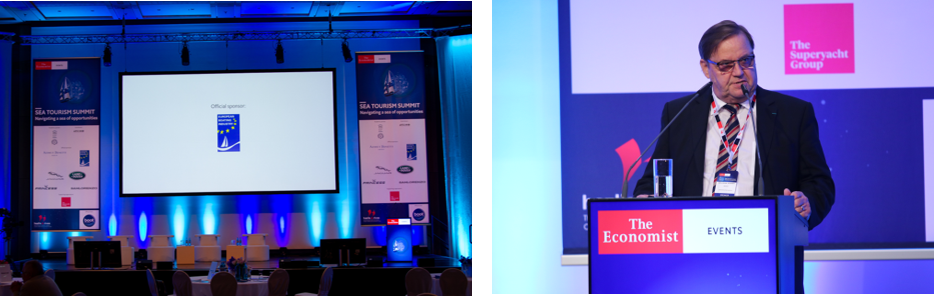
The first-ever Economist Sea Tourism Summit was organised ahead of boot Düsseldorf with around 200 participants discussing the future of nautical tourism. Speakers included industry leaders, policy-makers and other high-level participants. The event stood under the theme of “Navigating a sea of opportunities”. It provided many interesting panel discussions and presentations on the future of nautical tourism and the role that industry and policy-makers, as well as the positive impact of the industry. EBI was one of the sponsors of the event.
EBI President Jean-Pierre Goudant gave a keynote at the Summit, highlighting the importance of nautical tourism for economies, employment and in particular coastal and peripheral regions. He highlighted some key challenges for the industry, namely economic turbulence, adaptation to climate change, changing consumer demand and increase in sharing economy.
In his remarks, he also highlighted the key measures that can ensure a sustainable growth and increase employment in the recreational boating industry. This requires industry adaptation to solidify the existing interest in boating among younger generations, as well as innovation, digitalisation and a strong environmental perspective.
He emphasised the role of the EU institutions in supporting industry through: 1) Positive EU agenda towards promotion of nautical tourism , 2) Level playing field in tourism sector in regulation and taxation, 3) Research and innovation funding, 4) Stronger Single Market and 5) Mutual recognition of skipper licenses.
Several speakers provided their perspective on the future development of the nautical tourism industry. Robert Marx, President of BVWW underlined that boating tourism does not just refer to mega yachts, but the huge number of smaller boats that have a share of more than 80%. The smaller boats, especially as charter boats, have a substantial impact on the tourism economy. He called for an alignment of VAT rates for campsites and mooring berths. Yves Lyon-Caen, President of the French Leisure Marine Industry Federation FIN underlined the importance of environmental challenges and ensuring that the pleasure of being on the sea is the focus in engaging a new generation of customers.
Petros Michelidakis, Director of Boot Düsseldorf underlined the importance of having a strong future perspective for the indsustry. A key aspect to consider is that even though nautical tourism is a small part of the overall economy, is does not appear as small if one looks at the positive impact for society, economies and people benefiting from the sector.
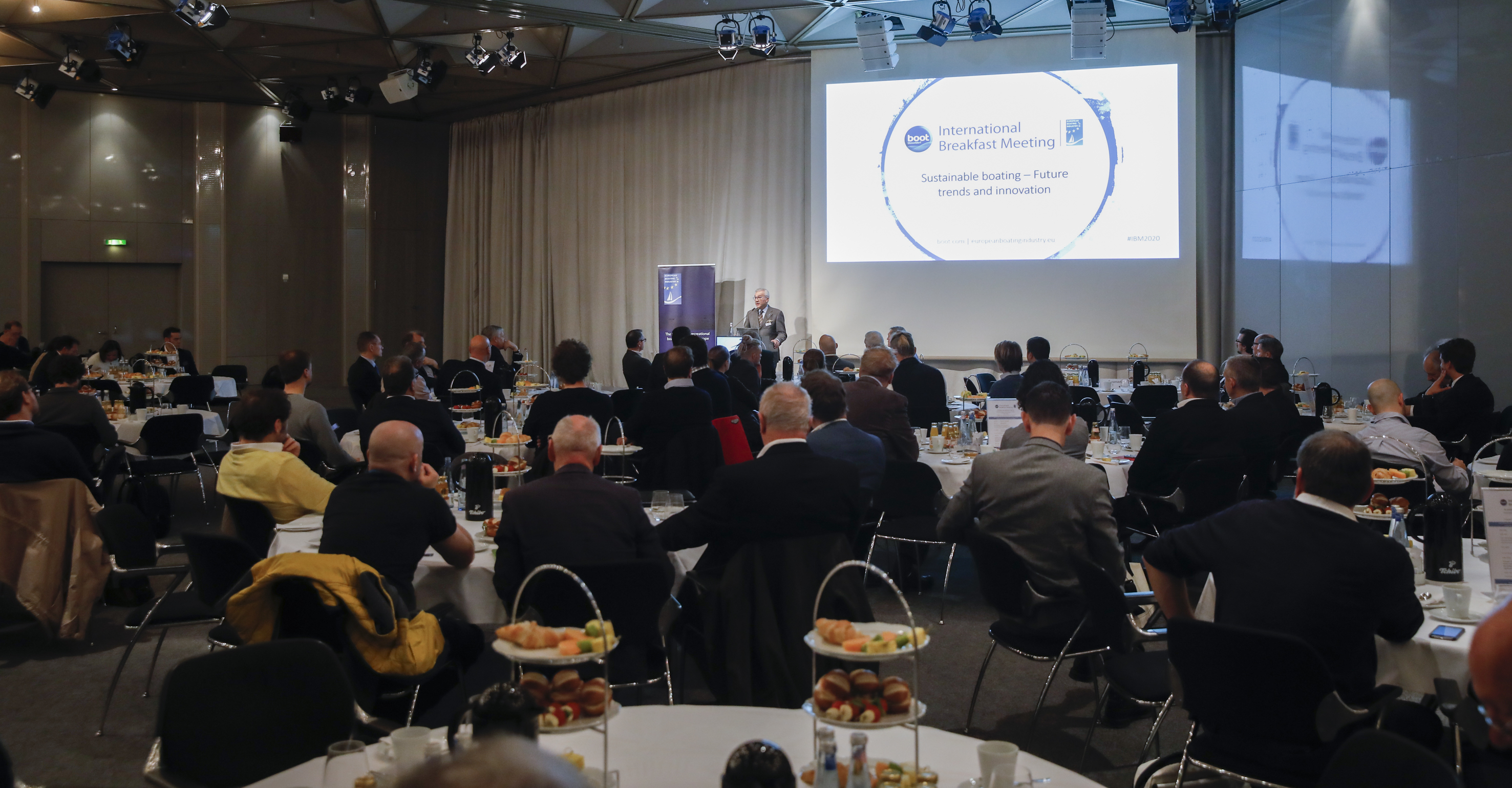 The 2020 edition of the International Breakfast meeting, co-organised by boot Düsseldorf and EBI on 21 January focused on the topic of sustainable boating. The European Green Deal, which has the ambition to make Europe the first climate-neutral continent was at the centre of the discussions followed by talks from electric, hybrid, hydrogen and digital innovators.
Drawing a record crowd of over 180 participants, the International Breakfast Meeting placed sustainability at the heart of the discussions. Welcoming participants, Petros Michelidakis (Director, boot Düsseldorf) said “Over 10 percent of the EU’s population participates in water sports and they want this to take place in a clean environment. The International Breakfast Meeting is the ideal location to discuss the key trends for our sector and proactively develop the future of sustainable boating.”
In his remarks, EBI President Jean-Pierre Goudant highlighted that “For our sector, moving towards sustainability and reducing our carbon footprint is crucial. As EBI, we see this as one of our key challenges for the coming years that we will advocate for. The International Breakfast Meeting clearly shows that our industry is innovating and proceeding on the right path.”
The keynote speech was given by Dr Artur Runge-Metzger (Director, European Commission Directorate-General for Climate Action). He presented the European Green Deal, which strives to make Europe the first climate-neutral continent by 2050 through a transformation towards environmental sustainability and tackling climate change. He highlighted the growth opportunities that this offers across all industries, including upcoming funding opportunities.
Laurent Perignon (Energy Observer Developments) presented the Energy Observer project, which uses a vessel as a test case to study various innovative technologies based on hydrogen. These have been tested, optimised and validated on its global travel. He also addressed upcoming bans of diesel engines in parts of Europe and the growth of marine protected areas as reasons for needing to focus on carbon neutrality in the marine sector. Energy Observer Developments has implemented several hydrogen solutions, including electro-hydrogen gensets for marine use with power ranging from 30 to 100 KVA running exclusively on hydrogen.
Vladimir Zinchenko (CEO, Greenline Yachts) presented the company, which produces vessels with hybrid, electric and Diesel engines. The aim is to shape the future of responsible boating through hybrid engines and ensure that the boats are easy to use for customers and provide the necessary comfort. He underlined that hybrid propulsion has the potential to attract boaters through the comfort of silence, constant power supply and cost savings.
Marteen Bernhart (Founder, La Bella Verde) presented the company, which runs catamaran day charters on Ibiza with new franchises in Brazil and Sidney. The catamarans are autonomous and use solar power and hydro-generation. A new area of their work are sustainable materials for the building of boats to address end-of-life recycling concerns, which La Bella Verde is doing through the development of a fully recyclable boat. In addition, their day-charter catamarans clean the oceans through nets that can be lowered into the water.
Simon Bühl (Founder & CEO, BrandUp Factory) provided an overview of the cross-over between digitisation and sustainability and the need for companies in the marine sector to move towards a big data-driven business model. The aim should be a structured collection and retention of data and a business model based on collaboration and adapted business culture.
Concluding the event, EBI Secretary-General Philip Easthill said “We are convinced that the environmental transformation of our industry will create new opportunities for growth in our sector. This must be based on three key pillars: Industry innovation, research and innovation funding, as well as policy that promotes sustainability. These are among the key topics for EBI in the coming years. We want sustainable boating to be made in Europe.”
To receive the presentations from the event, please contact the Secretary-General (pe(at)europoeanboatingindustry.eu).
 English
 Български
 Hrvatski
 Čeština
 Dansk
Dansk Nederlands
 Eesti
Eesti Suomi
Suomi Français
 Deutsch
 Ελληνικά
 Magyar
 Gaelige
 Italiano
 Latviešu valoda
 Lietuvių kalba
 Maltese
 Norsk bokmål
 Polski
 Português
 Română
 Русский
 Slovenščina
 Español
 Svenska