

- Home

- Newsroom
- Press releases
- Super User

Super User
The 2025 European Maritime Transport Environmental Report (EMTER), published by the European Maritime Safety Agency (EMSA) and the European Environment Agency (EEA), provides an updated assessment of the environmental impact of the maritime sector. While the industry remains crucial for trade and economic growth, it continues to contribute significantly to emissions, pollution, and biodiversity loss.
The report highlights that CO₂ emissions from maritime transport rose to 137.5 million tonnes in 2022, accounting for 3-4% of total EU emissions. While sulphur oxide (SOx) emissions have dropped by 70% since 2014, nitrogen oxide (NOx) emissions have increased by 10% since 2015. Other concerns include underwater noise pollution, plastic pellet spills, and the spread of invasive species through shipping routes.
The EU has introduced measures to accelerate decarbonisation, including the extension of the Emissions Trading System (ETS) to shipping in 2024 and the FuelEU Maritime Regulation coming into effect in 2025. However, the transition to cleaner fuels will require significant investment in production capacity and infrastructure.
Read the report here.
New Life Cycle Assessment (LCA) data has been released for Unsaturated Polyester (UP) and Vinyl Ester (VE) resins, providing updated insights into their environmental impact. This was done by the CEFIC UP/VE Sector Group. These materials are widely used in boatbuilding, and the new data offers manufacturers a more accurate evaluation of their footprint across various stages of the product lifecycle.
The updated LCA data has been developed in collaboration with industry stakeholders, ensuring a comprehensive assessment of key environmental factors such as energy use, emissions, and resource consumption. By integrating these insights, companies can make more informed decisions about material selection, sustainability strategies, and compliance with evolving environmental standards.
For more information, check the press release.
The EU Commission has launched the Clean Industrial Deal (CID) and the Affordable Energy Action Plan (AEAP), marking a major step in the EU’s strategy to balance decarbonisation and industrial competitiveness. These initiatives aim to reduce energy costs, enhance resource efficiency, and strengthen the competitiveness of European industry in a rapidly evolving global market.
The CID mobilises over €100 billion to support clean manufacturing, circular economy practices, and the transition to renewable energy. The plan includes measures to lower energy costs, promote bio-based materials, and accelerate the adoption of low-carbon technologies, directly impacting energy-intensive industries such as boatbuilding and related supply chains. A Sustainable Transport Investment Plan, also part of the package, prioritises renewable and low-carbon fuels for waterborne transport, supporting the maritime sector’s shift towards greener energy sources.
Circularity is at the core of the EU’s long-term strategy, with the Circular Economy Act planned for 2026, aiming to increase the use of recycled and bio-based materials over fossil-based ones. The Commission is also working on harmonising carbon accounting methods and improving transparency through product labelling, helping businesses and consumers better assess environmental impacts.
Key aspects to the boating industry include cross-industry benefits aimed at lowering energy prices and mobilising investment for EU-made clean manufacturing. Potential regulatory changes to align industries with the future EU 2040 climate targets may influence the revision of the Recreational Craft Directive. Developing comprehensive life-cycle assessments will support the industry. Additionally, the Sustainable Transport Investment Plan includes short-and medium-term measures to prioritise support for specific renewable and low-carbon fuels for aviation and waterborne transport.
On the same day, the Commission introduced the first Regulatory Simplification package, designed to streamline compliance requirements while maintaining sustainability objectives. This package includes adjustments to the Corporate Sustainability Due Diligence Directive (CSDDD), Corporate Sustainability Reporting Directive (CSRD), Taxonomy Regulation, and Carbon Border Adjustment Mechanism (CBAM), with changes that delay implementation timelines, simplify reporting obligations, and rescope compliance requirements to reduce regulatory burdens for businesses.
For companies in the scope of these reporting requirements, EBI asks for feedback on these proposals and how these Regulatory Simplification packages can support them best. EBI may provide feedback to the EU Commission based on feedback from businesses.
For more information on the announcement, click here.
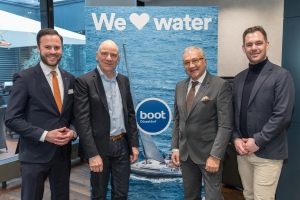
 European Boating Industry (EBI) and boot Düsseldorf proudly announce the renewal of their collaboration for an additional three years, extending their successful partnership until 2028.
This agreement ensures the continued organisation of the flagship Breakfast Meeting and Blue Innovation Dock, key events that drive innovation, foster dialogue between industry and policymakers, and enhance the sector’s competitiveness. Building on the resounding success of the Breakfast Meeting, which marked its 10th edition this year, EBI will maintain its role in shaping boot Düsseldorf’s B2B programme. These events serve as critical platforms for addressing the key issues of market hot topics, digitalisation, and sustainability providing business leaders with strategic insights and opportunities for growth.
The agreement was formalised by Marius Berlemann (COO of Messe Düsseldorf), Petros Michelidakis (Director of boot Düsseldorf), Robert Marx (President of EBI) and Philip Easthill ( Secretary-General of EBI). Their shared commitment underscores the importance of continued collaboration in shaping the future of the boating industry.
“For us, the collaboration with EBI is an important building block for expanding the B2B programme at boot Düsseldorf. This interaction gives us the perfect opportunity to attract high-profile speakers for the blue innovation dock sustainability forum. In addition, the breakfast meeting is a valuable medium for industry representatives to network internationally. I am very pleased that we will continue to have a competent partner in the EBI in the future”, explains boot Director Petros Michelidakis.
Philip Easthill, Secretary-General of EBI, highlighted the significance of the partnership:
“The renewal of our agreement with boot Düsseldorf for three years is a milestone for EBI and the industry. It reflects our shared commitment to innovation, collaboration, and leading the way in addressing tomorrow’s challenges and opportunities today. We are grateful for the support of boot Düsseldorf.”
boot Düsseldorf will continue to be a central hub for innovation and industry dialogue. The next edition will take place from 17 to 25 January 2026, with the Blue Innovation Dock stage running throughout the entire duration of the show and the Breakfast Meeting scheduled for Tuesday, 20 January. These events will provide, once again, unparalleled opportunities for industry leaders, policymakers, and stakeholders to connect, exchange insights, and drive forward the sector’s most pressing topics.
Foiling World made its debut at boot Düsseldorf 2025, offering a cutting-edge showcase of the modern foiling industry. The event featured state-of-the-art technologies, expert discussions, and exhibits ranging from foiling boards to flying electric boats, with industry leaders like Flite and Candela presenting their latest innovations.
Highlights included insights into offshore foiling competitions such as the IMOCA class, The Ocean Race, and the Vendée Globe, alongside advanced safety demonstrations, eSports simulators, and revolutionary concept boats. Renowned sailors Dee Caffari, Elizabeth Tucker, and Cole Brauer also shared their experiences live from the Indian Ocean.
EBI was proud to collaborate with Foiling World at boot Düsseldorf, hosting the President of the Foiling Organisation and other key representatives at the Blue Innovation Dock to showcase groundbreaking and sustainable foiling technologies.
At boot Düsseldorf 2025, Slovenian startup VisionAnchor obtained the first place in the yearly Start-up pitch competition organized by Yachting Ventures and EBI. Their innovative product, the VisionAnchor S buoy, enhances anchoring safety for vessels between 8 to 25 meters by utilizing advanced GPS technology. As the competition winner, VisionAnchor was awarded with media coverage and a complimentary stand for all nine days at next year's boot Düsseldorf.
VisionAnchor has received recognition from esteemed organizations such as EIT Digital and the European Space Agency (ESA). They also participated in the Techstars global startup accelerator in Turin, Italy. Looking ahead, the company plans to scale production in Slovenia and expand into markets including the United States and Australia, actively seeking additional investment to support these ambitions.
EBI is proud to co-host the Start-up competition with Yachting Venture every year on the stage of the blue innovation dock. It is a day dedicated to great ideas and innovative solutions which bring different sectors of the boating industry together.
EBI held its first General Assembly of the year during boot Düsseldorf, welcoming the Bulgarian Association of Boating Industry (BABI) as its newest member. With this addition, EBI now represents 30 members across Europe, further strengthening its advocacy for the recreational boating sector.
BABI was founded by Elica Yard, LZ Yachting 1991, Crooze Yachts Bulgaria, and Dream Sea Yachting to position Bulgaria as a high-quality yacht-building hub. The association aims to boost the country's marine industry by supporting yacht manufacturers, brokers, and charter companies, while also encouraging yachting as a leisure activity.
This new partnership reflects the commitment of the European boating industry to sustainable growth and innovation. For the full press release, follow the link.
Leading marine trade associations, the International Council of Marine Industry Associations (ICOMIA), European Boating Industry (EBI), and National Marine Manufacturers Association (NMMA) announced they are joining together to develop a global recreational marine lifecycle assessment (LCA) framework. This partnership establishes the first-ever global collaboration to assess, measure and report the industry’s environmental performance of recreational boats. This first-ever collaboration unites the global recreational marine industry to accelerate progress in developing a shared approach to quantifying environmental performance across a range of technologies.
As part of ongoing efforts to demonstrate environmental stewardship and harmonise global sustainability initiatives, and the recreational marine industry is committed to achieving a comprehensive framework that provides a methodology that quantifies the environmental performance of a recreational boat through every phase of its life, including raw materials, production, use phase, disposal and recycling.
EBI and NMMA recognise that ensuring the long-term resilience of the recreational marine industry requires forward-thinking sustainability strategies that balance business growth with responsible practices. Developing a global approach to assessing the full lifecycle of products is a critical step in helping manufacturers make informed decisions that strengthen their operations, supply chains, and product design while meeting evolving market expectations. This work will provide a practical framework for companies to innovate and support a long-standing commitment to the environment that ensures future generations’ continued ability to enjoy the unique experiences boating provides. The LCA work builds on the Propelling Our Future initiative, a global industry effort to equip the industry with knowledge on the multiple technologies needed to move the industry toward decarbonisation.
“EBI has been developing an LCA methodology for the European market given some of our members’ more immediate needs and the collaboration with ICOMIA and NMMA provides a long-term globally aligned solution. The final collaborative LCA methodology will allow us to improve environmental performance and transform the future of the global industry. We are glad to open our doors to our global partners to work on the next phase,” said Robert Marx, President of EBI. "A harmonised lifecycle assessment is crucial to moving the industry forward in lockstep—from eco-design to navigating the regulatory landscape and ensuring we continue to do our part to protect the environment.”
ICOMIA, EBI and NMMA will complete an extensive review of LCA methodologies to identify the most relevant approach for the global market, building on the projects already completed or underway with EBI’s Blue Boat Horizon project and ICOMIA’s Marine Engine Committee (IMEC). In addition to the methodology, the global recreational marine lifecycle assessment project will ultimately include the development of standard inventory databases, tools, communications materials and educational initiatives to help manufacturers and other marine organisations.
As the LCA is built, ICOMIA, EBI and NMMA will convene a global task force with involvement from associations and companies around the world. The joint task force will consist of several committees focused on technical input and guidance; assessing and preparing for a successful rollout of the final LCA; industry education and training; and public policy/affairs and communications.
A recent study commissioned by the European Parliament examines the growing significance of silver tourism, a key segment of the longevity economy that caters to older travellers. With the EU’s population over 65 expected to reach 30% by 2050, tourism spending by those aged 55+ is projected to more than double, reaching €369.5 billion by 2040.
The study identifies six key categories within silver tourism—wellness, accessible, medical, multi-generational, smart tourism, and international retirement migration (IRM). It highlights both opportunities and challenges in these sectors, including barriers related to accessibility, infrastructure, and ageism.
For the recreational boating sector, this presents an opportunity to develop new services and products tailored to the needs of older tourists, such as accessible marinas, boat rental packages designed for multi-generational travel, and wellness-themed cruises. Silver tourism can help boost off-season revenue and create year-round demand for nautical tourism services, contributing to the resilience and growth of coastal economies.
Policy recommendations from the study include developing an EU roadmap for silver tourism, enhancing EU-wide cooperation, and promoting inclusive marketing and training initiatives. The recommendations also emphasise the need for stronger research, data collection, and funding to support sustainable tourism infrastructure.
For more details, access the study here.
 English
 Български
 Hrvatski
 Čeština
 Dansk
Dansk Nederlands
 Eesti
Eesti Suomi
Suomi Français
 Deutsch
 Ελληνικά
 Magyar
 Gaelige
 Italiano
 Latviešu valoda
 Lietuvių kalba
 Maltese
 Norsk bokmål
 Polski
 Português
 Română
 Русский
 Slovenščina
 Español
 Svenska