

- Home

- Newsroom
- Press releases
- Super User

Super User
On 2 July, the EU Commission adopted its proposal to amend the European Climate Law, introducing a legally binding target to reduce net greenhouse gas emissions by 90% by 2040 compared to 1990 levels. The proposal follows repeated delays and aims to provide clarity on the EU’s trajectory between the 2030 and 2050 milestones.
The proposal includes a limited role for international carbon credits from 2036, the integration of permanent domestic removals into the EU Emissions Trading System, and more flexibility for Member States in determining sectoral contributions. The Commission underlined the need to ensure industrial competitiveness by supporting all zero- and low-carbon energy solutions, including renewables, nuclear, and carbon capture technologies.
The file will now move to the Council and European Parliament for negotiations under the ordinary legislative procedure. The outcome will define how the EU balances ambition, flexibility, and competitiveness on its path to climate neutrality by 2050.
Brussels, 29 July 2025 – European Boating Industry (EBI) takes note of the announcement on trade by EU Commission President von der Leyen and US President Trump on Sunday. It provides predictability and stability ahead of the important boat show season in Europe.
Although it averts the worst of a detrimental trade war, the increase of tariffs to 15% will be very challenging for many businesses and SMEs in Europe. Until the US announcement in April, US tariffs were largely around 1–2%, allowing a trade relationship on an equal footing. Exports of recreational boats to the US in 2023 were around $1.8 billion, and the additional costs from these new tariffs will be in the tens of millions. It also creates the risk of an unbalanced trade relationship between the EU and US, and negatively affects EU competitiveness.
Philip Easthill, EBI Secretary-General, commented: "The US is the most important export market for the recreational boating industry in Europe. Stability and predictability is vital, but equally important is a trading environment that businesses can sustain. This deal is not sufficient. The 15% tariff rate presents serious challenges for businesses in Europe. We call on the EU Commission to take the announcement as the basis for more sectoral negotiations and consider the needs of export-reliant industries such as ours.
We are committed to working with our members to navigate these challenges and continue advocating for the best interests of the boating sector in Europe. The EU and the US should focus on reducing obstacles to transatlantic trade, which will lead to significant benefits for businesses and jobs on both sides of the Atlantic.
In addition, a better regulatory environment needs to be created to grow the European market, reduce red tape, and support our sector across all areas—from trade to investment, environmental and industry policy."
The text of the agreement has not yet been published and EBI will provide further assessment at a later stage. EBI will continue to be in constant dialogue with the EU institutions.
Recreational boat building is a unique keystone industry that has served as a pillar of our economies and cultures for hundreds of years. But the craft nature of boatbuilding and boat maintenance relies upon carefully cultivated supply chains to succeed, with an expectation that inputs can flow freely, consistently, and efficiently across borders. Unpredictable tariff regimes create significant risks that threaten both economic growth and highly skilled jobs in each of our regions.
As representatives of global leisure marine industries, we therefore call on our respective governments to support a business operating landscape that provides fair and predictable trade. Boating is a significant driver of economic activity, local, nationally, and globally.
- Boating and fishing are the largest contributors to America’s $1.2 trillion outdoor recreation economy with a strong made in America role, and $230 billion in annual economic activity.
- The boating and nautical tourism industry supports the EU’s €890 billion blue economy and the boating industry is one of the largest European export sectors.
- Small and Medium Enterprises are strongly represented in the UK, Australia, and in other nations with emerging opportunities across the Indo-Pacific region.
Further, every dollar of direct spending in this sector generates at least another 60 cents in economic activity and every two sector jobs create at least one additional job in related industries and services.
The design, build and distribution of boats, including raw materials and components, supports a highly skilled workforce. Small and medium-sized businesses are common and are meaningful sources of employment as well as serving as a strong foundation for their local communities. For instance, 96% of sector participants in the EU are small locally owned business that directly employ more than 280,000 employees2 across 32,000 businesses. In the U.S., 93% of the marine industry are small businesses, supporting over 800,000 jobs.
At their core, these internationally connected yet locally focused businesses do much more than just support economic growth and skilled employment. They also proudly facilitate sport, tourism, leisure, well-being, heritage, and tradition. But they require business certainty at global, national, and local levels to succeed. By pursuing fair and predictable trade that lowers tariffs and breaks down trade barriers – along with more harmonized operational landscapes with regard to safety, access, standards, and other protocols – our governments can mutually support our distinct interests and the many markets our businesses serve.
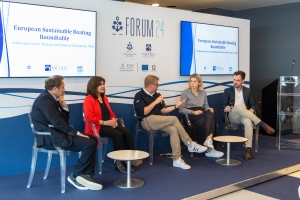
European Boating Industry (EBI) and Confindustria Nautica are pleased to announce the third edition of the European Sustainable Boating Roundtable, a high-level meeting place between industry and policy event taking place on Friday, 19 September 2025 at 15:00, Forum Hall at the Genoa International Boat Show. This Third European Sustainable Boating Roundtable will build on the success of the past two editions and serve as a key forum for dialogue on the sector’s sustainability and long-term competitiveness.

2nd European Sustainable Boating Roundtable
Under the theme "Resilient & sustainable growth amid global trade shifts" the roundtable will address the strategic importance of the boating industry for regional economies, the sector’s contribution to international trade stability amidst current global economic uncertainty, and how EU policy can further support the industry's long-term economic sustainability and competitiveness. Given that EU manufacturers are by far the largest exporters of recreational boats, the current shifts in trade and geopolitics are forecast to impact the sector and new strategies will need to be found.
The Roundtable will be opened by Executive Vice-President of the European Commission Raffaele Fitto, whose participation brings high-level political weight to the event. As the Commissioner responsible for Cohesion, Reforms, and strategic oversight of tourism, transport and the blue economy, his presence underlines the importance of aligning regional policy with the future of Europe’s sustainable boating and tourism sectors. This is the first engagement of an EU Commission Executive Vice-President in this mandate of the EU Commission at a boat show.
Panellists for the event include Members of the European Parliament MEP Francesco Torselli and MEP Brando Benifei from Italy, and MEP Željana Zovko from Croatia, as well as Sebastian Nietupski, CEO of Kotniz Group and former President of Polboat. The roundtable will explore how European policy and industry collaboration can reinforce the resilience of Europe's boating sector, bolster regional economic growth, and sustain Europe’s excellence and competitive edge in the global markets.
This event continues to build on the success of previous editions. The Roundtable has established itself as a key platform for policymakers and industry experts to exchange strategic insights and best practices for the boating sector’s long-term prosperity. It is a key opportunity for industry to directly engage with EU policymakers at the start of the important summer season.
Robert Marx, President of EBI said about the event: “We are excited for the third edition of the EBI Roundtable at the 65 edition of the Genoa International Boat Show and a discussion at a critical time. The ability of our industry to remain competitive depends not only on innovation, but on stable and supportive policy. With the current challenges in global trade, it's more important than ever that we engage directly with EU decision-makers. This Roundtable creates the space for that dialogue and ensures the voice of the boating industry is clearly heard.”
Piero Formenti, President of Confindustria Nautica, stated: “The European Sustainable Boating Roundtable is a key moment to show how Europe’s boating industry is driving sustainability and competitiveness on the global stage. Together with our partner European Boating Industry, we’re proud to host this third edition at the Genoa International Boat Show – which, on the same day, will also feature the World Yachting Sustainability Forum, confirming the Show as the central hub for innovation in our sector.”
Fabio Planamente, Vice President of Confindustria Nautica and newly appointed EBI Special Representative for the Large Yacht Sector, commented: “Holding roles within both Confindustria Nautica and EBI provides a unique opportunity to reinforce the alignment between national priorities and European strategies. The Roundtable represents a pivotal platform to promote a shared vision for a sustainable and competitive future for the boating industry, ensuring our sector’s interests are effectively represented in the European policy arena.”
Early registration is strongly recommended as seating is limited. To secure your place, please register promptly via the following link.
EBI and the European Fishing Tackle & Trade Association (EFTTA) announced a strategic partnership to boost cooperation between Europe’s recreational boating and fishing sectors. The alliance is rooted in shared priorities—sustainability, innovation, and sectoral growth.
The agreement sets out a joint approach to advocacy, data sharing, and public engagement, with a focus on marine access, environmental responsibility, and qualifications. EBI and EFTTA will collaborate through major events such as the EFTTA Angling Summit and EBI’s Blue Innovation Dock, while maintaining their institutional independence.
You can find the full press release at this link.
At its General Assembly in Hamburg on 17 June, EBI welcomed new members and renewed its leadership. The French Federation of Pleasure Ports (FFPP) and Portugal’s ACAP APICAN joined EBI, bringing membership to 32 organisations across 21 countries. EBI also approved the return of the Slovenian Marine Industry Association (SMIA), marking a new phase of engagement under the leadership of its new President Matjaž Murko.
The Assembly re-elected Robert Marx (VMWD/Germany) as President for a second term, alongside Anne-Marie Bouweraerts (Nautibel/Belgium) and Jean-Paul Chapeleau (FIN/France) as Vice-Presidents. Elected as Council members are Jordi Carrasco Abad (ANEN/Spain), Mirek Hajdukiewicz (POLBOAT/Poland), Jeroen van den Heuvel (HISWA-RECRON/ The Netherlands), Ana Calic (CEA/ Croatia), and Jarkko Pajusalo (FINNBOAT/Finland), and Fabio Planamente (Confindustria Nautica/Italy) appointed as special representative for the large yacht sector.
Discussions focused on EU policy developments, trade diversification, and boosting competitiveness in the boating industry. The event reaffirmed EBI’s role as the unified voice of the sector, driving sustainability and innovation forward.
Read the full press release here.
EBI was invited to participate in a high-level restricted meeting at the EU Industry Days in Rzeszów, Poland with Director-General of the EU Commission DG for Internal Market and Industry, Kerstin Jorna and Minister Baranowski (Polish Ministry of Economic Development and Technology/EU Presidency) together with all the top leadership of the EU Commission in this area.
At the roundtable, EBI Secretary-General Philip Easthill emphasised the urgent need to safeguard investment and economic stability in the EU by addressing escalating trade tensions with the US. Current US tariffs have already severely hampered exports, particularly affecting SMEs, and the proposed EU countermeasures threaten further disruption. With a thriving and export-driven recreational boating sector employing 280,000 people—96% in SMEs—and maintaining a strong 9:1 trade surplus with the US, the industry’s perspective is vital.
EBI warned that inclusion of boats and key components like outboard engines in countermeasures could risk thousands of jobs, destabilise supply chains, and damage EU competitiveness. It calls for their exclusion from EU retaliatory measures and urges a fresh policy evaluation. Furthermore, EBI advocates for a broader pro-investment strategy including regulatory simplification (especially the Recreational Craft Directive), integration into EU tourism and maritime industrial strategies, infrastructure investments in sustainable marinas, recognition of boating licenses across member states, and support for sustainable fuel transitions—all aimed at fostering a strong, resilient European boating sector.
The EU Commission representatives highlighted the need for a paradigm shift to complete the Single Market, simplify regulation, focus on competitiveness and urgently create better conditions for EU businesses. There was recognition that ‘overregulation is killing industry’ and a clear sense of urgency and prioritisation to support businesses to (continue to) choose Europe for their investments. Other sectors represented echoed this sentiment and requested horizontal and specific measures to urgently support their sectors.
 English
 Български
 Hrvatski
 Čeština
 Dansk
Dansk Nederlands
 Eesti
Eesti Suomi
Suomi Français
 Deutsch
 Ελληνικά
 Magyar
 Gaelige
 Italiano
 Latviešu valoda
 Lietuvių kalba
 Maltese
 Norsk bokmål
 Polski
 Português
 Română
 Русский
 Slovenščina
 Español
 Svenska