

- Home

- Newsroom
- Press releases
- Super User

Super User
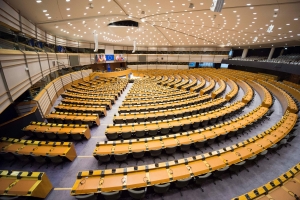
Brussels, 26 March 2021 – The European Parliament adopted its Report on Establishing an EU Strategy for Sustainable Tourism with a resounding majority. Through it, MEPs call for several measures to make tourism cleaner, safer and more sustainable, as well as to support the sector’s recovery. European Boating Industry (EBI) welcomes the report and calls on the Commission and on EU countries to implement the proposals. The report singles out the potential of nautical tourism and recreational boating through concrete support measures which EBI has been advocating.
The report was adopted on 25 March by the Parliament’s plenary, with 577 votes in favour, 31 votes against and 80 abstentions. It is non-binding but promises to be a precursor for future Commission initiatives and offers strong political support. Prior to that, the report had been approved by the Parliament’s Transport and Tourism Committee by 47 to 2.
The report stresses the grave impact that the COVID-19 pandemic has had on the tourism sector and proposes a wide array of measures to make tourism more environmentally friendly, diversified, and resilient to the crisis. It asks EU countries to implement common and coordinated criteria for safe travel, including a common vaccination certificate (as was proposed by the Commission last week, see Commission press release). It also calls for Member States to include travel and tourism in their recovery plans, in order to ensure that adequate investment is available for the sector’s modernisation and digitisation and makes investment proposals. In addition, the report proposes the creation of an EU hygiene certification seal and of an EU Agency for Tourism. Altogether, it aims for the ambition of a European Tourism Union.
At the plenary session, the report’s rapporteur, MEP Cláudia Monteiro de Aguiar, said: “The 27 Member State recovery programmes must have plans to cover the tourism sector. The EU has to bring its efforts together and push forward a European tourism plan. This report is key to make sure our compatriots understand that the EU has measures and has funding to help companies, institutions and citizens”.
EBI has been playing an active role in the report, being in close contact with the key MEPs and with its allies to provide input that reflects the needs of the sector. This has been successful, with a number of key points that EBI has been advocating finding cross-party support. Namely, the report:
- “Commends the Commission for its work on the 14 actions which make up the Strategy for Coastal and Maritime Tourism, and invites it to present the results, which can be used to channel financing to infrastructure (ports and marinas), logistical and operational support, waste prevention and the use of renewable energy; stresses the need to respect the maritime ecosystem, promote dialogue between Member States, regional and local authorities, stakeholders and civil society, and foster the sustainable development of coastal and maritime tourism.” (point 49)
- “Calls on the Commission to develop initiatives for nautical and coastal tourism with regard to the recognition of skipper qualifications, VAT rules on boats, marinas and anchorages, to tackle seasonality and promote cross-border routes, such as a network of routes for nautical tourism.” (point 50)
- “Urges the Commission to work together with associations in the sector and to use best practices to issue recommendations and provide financial support for the organisation of trade tourism events, fairs [and] congresses.” (point 70)
EBI Secretary-General Philip Easthill commented: “The tourism industry, which represented 11.2% of the EU’s employment and 10.3% of its GDP before the pandemic, has been extremely badly hit by the crisis. As EBI, we welcome the report, and we call on the Commission and on national governments to implement the many positive proposals put forward in it. In particular, we are very pleased that the importance of nautical tourism and recreational boating is acknowledged in the report. The sector is an essential element in the move towards a sustainable, diversified and resilient tourism sector, and it offers a real potential to help regions and related sectors recover from the crisis.”
This achievement is embedded in EBI’s strategy of working closely with the EU institutions and emphasising the role of the sector in tourism policy at EU level. Last September, the European Economic and Social Committee, an EU advisory body, published its opinion “Tourism and transport in 2020 and beyond”, which contained several proposals specific to boating and nautical tourism as a result of EBI’s advocacy efforts (see EBI press release). In addition, on 20 April, EBI and boot Düsseldorf will be holding the 2021 International Breakfast Meeting, an event involving high-level panellists from business and politics who will be discussing the present and future of the boating industry within tourism and recreation. It will include the participation of CommissionerVirginijus Sinkevičius, as well as MEP Ismail Ertug (information and registration here). Through these efforts, EBI aims to be at the forefront of policy discussions and decisions affecting the boating industry and nautical tourism.
The “Report on establishing an EU strategy for sustainable tourism” can be found here.
About European Boating Industry
European Boating Industry (EBI) represents the recreational boating industry in Europe. It encompasses all related sectors, such as boatbuilding, equipment manufacturing, marinas and service providers. The industry is a significant contributor to the European economy, representing 32,000 companies that employ over 280,000 people directly. The vast majority of the sector is made up of small- and medium-sized enterprises (SMEs). More information on EBI’s website: europeanboatingindustry.eu.
Press contact: This email address is being protected from spambots. You need JavaScript enabled to view it.
Brussels, 19 March 2021 - European Boating Industry, representing the recreational boating sector in Europe, and The SeaCleaners, the NGO created by sailor Yvan Bourgnon to combat plastic pollution, are holding a webinar on 19 May. It will introduce The SeaCleaners and present opportunities for boaters and the recreational boating industry to become involved in tackling marine litter.
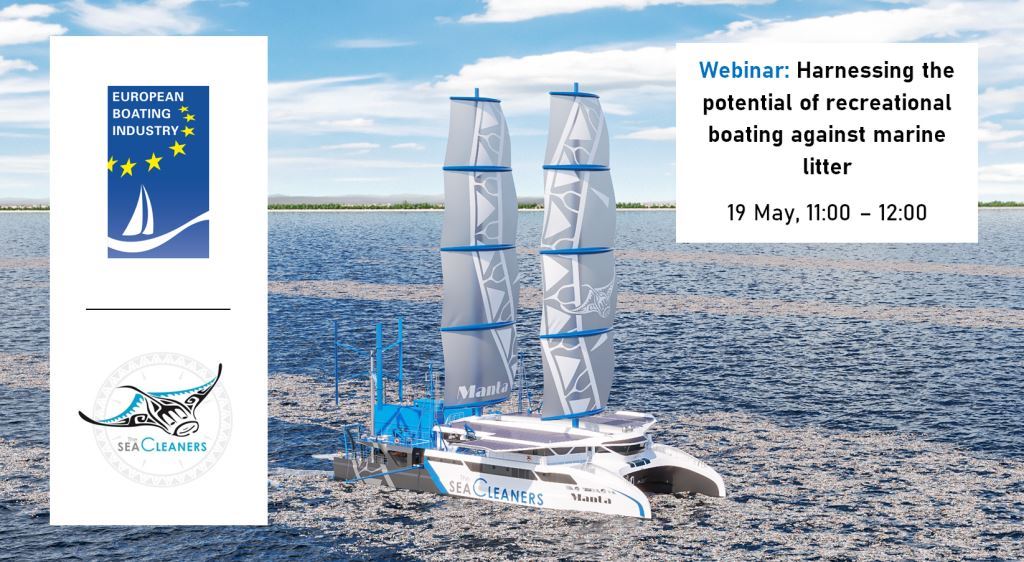
The webinar will be an opportunity for boating industry stakeholders, including companies and boaters, to engage with the issue of marine pollution. As a beneficiary of a clean and healthy marine environment, the boating community is a natural ally in protecting seas and oceans. The webinar is held on the occasion of European Maritime Day, which provides every year an opportunity for EU citizens to engage with maritime affairs and sustainable blue growth through events across Europe.
The event will include the participation of Yvan Bourgnon, President and founder of The SeaCleaners, as well as its Technical Director Frederic Silvert, who will share technological insights of the Manta, the flagship project of The SeaCleaners. The Manta is a revolutionary vessel currently being developed, which will be powered by renewable energy. It will collect and process floating waste, capable of collecting up to 3 tonnes of debris per hour. The webinar will be moderated by Valérie Amant, Director of Communications at The SeaCleaners. Andreea Strachinescu, Head of Unit for Maritime innovation, Marine Knowledge and Investment in the European Commission’s Directorate-General for Maritime Affairs and Fisheries, will also present the EU’s actions against marine litter and involvement of different actors in plastic waste collection.
Following the presentations, the audience will be engaged through a Q&A session. Various opportunities for support and involvement in the The SeaCleaners’ mission will be presented to participants in this practical and interactive webinar.
The webinar is the first activity organised in the framework of the collaboration between The SeaCleaners and European Boating Industry, which was formalised through a Memorandum of Understanding in January 2021.
The webinar will take place on 19 May, 11:00 – 12:00 and is open to all participants.
About European Boating Industry
European Boating Industry (EBI) represents the recreational boating industry in Europe, which encompasses boatbuilders (building motorboats, sailing boats, yachts, personal watercraft, and other recreational boats), engine manufacturers, equipment manufacters, refit and maintenance companies, boat dealers and importers, marinas and yacht harbours, boat charter and rental companies, water sports rental companies, andother related companies.
EBI's members are the national associations representing the recreational boating industry, as well as a number of individual companies (sustaining members). EBI is an established stakeholder at EU level, defending and promoting the interests of its members on key issues ranging from Single Market legislation to blue growth, tourism and trade policy. In Europe, the recreational boating industry is made up of 32,000 companies (mostly SMEs) which directly employ over 280,000 people. The sector is a key contributor to tourism and to local economies in coastal and island regions, and Europe is an important exporter of recreational boating products.
More about EBI: europeanboatingindustry.eu
About The SeaCleaners
Created in 2016 by the French-Swiss navigator and explorer Yvan Bourgnon, the organisation offers solutions against plastic pollution through corrective and preventive actions. An Observer Member of the United Nations Environment Programme, supported by the Albert II Foundation of Monaco and the CCI France International, The SeaCleaners has four objectives:
- Collection of floating waste at sea, coastal line and rivers as well as organisation of clean-ups on land.
- Education and pedagogy, with the development of awareness-raising activities for the populations affected, the public and decision-makers.
- Advancement of scientific research.
- Transition towards circular economy based on valorisation of collected waste.
The association’s flagship project is The Manta, a revolutionary vessel showcasing The SeaCleaners’ solutions: powered by renewable energy, this giant of the seas will be the first deep-sea vessel capable of collecting and mass processing floating oceanic waste before it fragments and enters the marine ecosystem in a lastingly manner.
More about The SeaCleaners: theseacleaners.org
Press contacts:
For The SeaCleaners – Valérie Amant – This email address is being protected from spambots. You need JavaScript enabled to view it.
For European Boating Industry – This email address is being protected from spambots. You need JavaScript enabled to view it.
 Brussels/Düsseldorf 11 March 2021 – European Commissioner for the Environment, Oceans and Fisheries, Virginijus Sinkevičius, will participate in the 2021 International Breakfast Meeting on 20 April. He and other high-level panellists from business and politics will discuss the impacts of the COVID-19 crisis on the recreational boating industry, recovery, new trends and opportunities.
The full agenda for the 2021 International Breakfast Meeting, organised by boot Düsseldorf and European Boating Industry, has now been released. The event, which will exceptionally be held online, will offer industry visitors and journalists the opportunity to exchange information on the latest market trends, regulations and innovation, as well as to develop new contacts and networks.
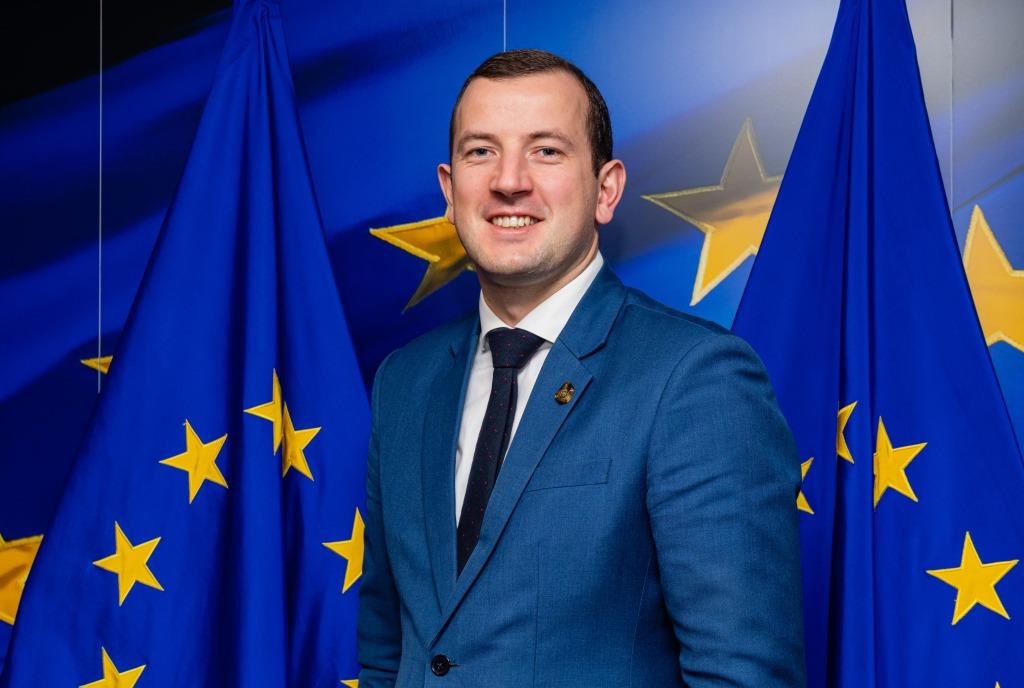 Virginijus Sinkevičius, European Commissioner for the Environment, Oceans and Fisheries, will participate at the event by video message. The Commissioner is responsible for the blue economy, including nautical tourism, the circular economy, as well as contributing to the implementation of the European Green Deal. This is the first time a European Commissioner participates at the International Breakfast Meeting, showing the increasing importance of the event and interest from the EU institutions.
Other speakers include Petros Michelidakis (Director of boot Düsseldorf), Ismail Ertug (Member of the European Parliament), Amelie Cesar and Natascha Zwenke (Jade University of Applied Sciences Wilhelmshaven, who led a study into the impact of Covid-19 on the boating industry), Lyublena Dimova (Research Manager at the European Travel Commission) and Gianguido Girotti (Deputy CEO of Groupe Bénéteau). The event will be moderated by Philip Easthill (Secretary-General of EBI).
The theme of this year’s edition will be “A Corona reboot of tourism and recreation – What future for boating?”. The event will include the presentation of a study on the impact of Covid-19 on the industry and the industry’s outlook. In addition, discussions will focus on new trends in travel and tourism, the future EU tourism strategy, and how to build momentum for boating in 2021 and beyond. The 2021 International Breakfast Meeting will take place on 20 April from 10:00 to 11:45 (CEST). Registration for the event, together with the agenda, can be found here: .
Further information about the Breakfast Meeting is available here: https://www.boot.com/en/Trade_Visitors/Events_for_Trade_Visitors/International_Breakfast_Meeting.
About boot Düsseldorf
boot Düsseldorf is the biggest boat and water sports trade fair in the world with almost 250,000 visitors and is the place where all of the industry meets every January. About 2,000 exhibitors are presenting their interesting innovations, attractive new developments and maritime equipment with the next edition taking place from 22 to 30 January 2022. The market will be coming to Düsseldorf to provide an exciting insight into the entire water sports world for the nine-day exhibition covering 220,000 square metres in 17 different halls. There is something for every water sports enthusiast, with the main focus on boats and yachts, motors and engine technology, equipment and accessories, services, canoes, kayaks, kitesurfing, rowing, diving, surfing, wakeboarding, windsurfing, SUP, fishing, maritime art, marinas, water sports facilities, beach resorts and chartering. All necessary information can be found on boot Düsseldorf’s website, boot.com.
Press contact: Tania Vellen, Phone: +49 211 4560 518, Email: This email address is being protected from spambots. You need JavaScript enabled to view it. and Cathrin Neitzel, Phone: +49 211 4560 589, Email: This email address is being protected from spambots. You need JavaScript enabled to view it.
About European Boating Industry
European Boating Industry (EBI) represents the recreational boating industry in Europe. It encompasses all related sectors, such as boatbuilding, equipment manufacturing, marinas and service providers. The industry is a significant contributor to the European economy, representing 32,000 companies that employ over 280,000 people directly. The vast majority of the sector is made up of Small- and Medium-sized Enterprises (SMEs). More information on EBI’s website: europeanboatingindustry.eu.
Press contact: This email address is being protected from spambots. You need JavaScript enabled to view it.
On 18 February, the Commission announced its new trade strategy, one that is “open, strategic and assertive, emphasising the EU’s ability to make its own choices and shape the world around it”, according to Trade Commissioner Valdis Dombrovskis. The strategy was drafted after a wide public consultation, which included input from EBI based on its position paper on international trade.
The strategy contains several key themes. Firstly, there will be a focus on the EU’s green and digital transitions: the new trade policy will contribute to the objectives of the European Green Deal and will remove unjustified trade barriers in the digital economy. Secondly, it will prioritise the reform of the World Trade Organisation, for instance through restoring the WTO’s dispute settlement system.
Furthermore, the EU’s trade strategy will become more assertive, namely regarding the implementation and enforcement of its trade agreements. In that respect, it will fight unfair trade, address sustainability issues and ensure agreements deliver on benefits to EU stakeholders. Finally, the strategy mentions the need to reinforce the EU’s alliances, both with its neighbours and with the US. Related to the US, the strategy will aim at enhancing regulatory dialogue and developing a closer transatlantic partnership on the green and digital transformation including through the EU-US Trade and Technology Council.
Other actions envisaged are the conclusion of bilateral agreements with key growth markets, such as in Asia Pacific and Latin America regions. New tools will be developed to support EU businesses, in particular SMEs.
More information together with the full strategy can be found here.
Organised by FIN (the French Federation of Nautical Industries), Virtual Nautic will be a unique, immersive and virtual boat show held on 12 and 13 March. Conceived as a solution to the Covid-19 restrictions, Virtual Nautic will include 150 booths, bringing together over a thousand professionals and an expected 25 000-30 000 visitors.
FIN has partnered with Virbela and Laval Virtual to create a virtual world that replicates the experience of in-person boat shows, through a virtual platform that will be easy to use, accessible and available in several languages. Access will be free of charge.
Upon registering, users receive a link to download an application on their computer, enabling them to create their avatar. On the day of the event, attendees will be able to move from one booth to another with their avatars, use direct voice chats with exhibitors, use presentation tools, schedule appointments, or look for products, services or destinations. An appointment scheduling tool will be shared in the coming days. In addition, conferences, round tables and workshops will also be held.
This is an opportunity for users to meet professionals, whether they be boat manufacturers, equipment suppliers, engine manufacturers or charter companies. It is also an opportunity for the marine leisure industry to meet new clients amid the Covid-19 pandemic. Several new sailboats, motorboats and catamarans will be presented for the first time during the event. In addition, among the 150 booths, around 30 French tourist destinations, both maritime and river-related, will be present.
Find more information and register on the Virtual Nautic website.
The EU-funded Medskippers project has the goal of boosting charter and nautical tourism, creating sustainable professional networks across the Mediterranean Sea, improving training and recognition of professional skippers of Small Commercial Vessels (SCV) and attracting the youth towards maritime professions. It will be organising the following two webinars in the coming weeks, specifically aimed at professional skippers:
- Webinar on environmental impact reduction, in order to help professional skippers upgrade their knowledge of the impact that marinas, boats, equipment and charter operations have on the environment, and how this impact can be reduced. 2 March at 12:00 (part 1) and 9 March at 12:00 (part 2). More information here.
- Webinar on ocean literacy, to help professional skippers upgrade their knowledge of the ocean's influence on them and their influence on the ocean, in order to eventually help them take responsible decisions concerning the sustainability and protection of the ocean. 4 March at 11:00. More information here.
Organised by the University of South Brittany in the framework of the EU-funded FLOWER project (which aims to develop innovative flax fibre reinforcements for composite applications), this Conference, held on 22-23 April will highlight scientific work and industrial initiatives on the integration of bio-composite materials in maritime sectors. It will include keynote talks, scientific presentations, company pitches, and individual meetings. The conference will take palce online. More information and registration can be found here.
The European Tourism Manifesto, together with its members, including EBI, has released a series of recommendations for Member States to relaunch travel and tourism in Europe in time for summer 2021, under the title “Exit Strategy: preparing to restart travel and tourism”. The document aims to achieve a joint way forward towards restoring travel and tourism and freedom of movement, and has been shared with all 27 governments and EU institutions.
The key proposal is the creation of a Commission Task Force for the restoration of free movement of people. Such Task Force would track the progress and impact of vaccination campaigns and mitigation measures (tests and quarantines), and would develop and implement a roadmap that would ensure a coordinated return to free movement. This roadmap would be updated regularly, reflecting changes in the development of the pandemic. The travel and tourism sector should be closely involved.
Other measures include coordination among governments on travel restrictions and requirements to offer predictability to travellers, business and workers; a harmonised EU framework for travel-related testing, that includes affordable testing, mutual recognition of tests between Member States, and the validation of rapid tests for travel and tourism purposes; coordination on national initiatives on E-health initiatives, allowing fast and digital verification of travellers’ vaccination or test status; and coordination in the reopening of tourism activities.
The full Exit Strategy can be found here.
The European Tourism Manifesto alliance, which is made up of over 60 European public and private tourism-related organisations (including EBI), has published a paper titled “Call for action: Accelerate social and economic recovery by investing in sustainable tourism development”, presenting a non-exhaustive list of reforms and investment ideas related to travel and tourism. The alliance advocates for these to be implemented through national recovery plans, which are currently being finalised and which will receive funding from the EU’s Recovery and Resilience Facility. Thanks to input from EBI, the role of boating and nautical tourism is very present in the paper.
The travel and tourism sector accounts for 9.5% of the EU’s GDP and is largely made up of SMEs. It provides jobs for 22.6 million people, and it is estimated that €1 of value generated by tourism results in an additional 56 cents of added value in indirect effects on other industries. However, the sector has been substantially hit by the COVID-19 pandemic, and €161 billion worth of investment is necessary for it to return to pre-crisis levels. The EU’s Recovery and Resilience Facility, together with national recovery plans, presents an opportunity for investment in the tourism sector, in particular to enhance the sector’s resilience and to advance in its green and digital transitions.
The wide range of proposals includes, for instance, the greening of buildings used for tourism, the upscaling of circular economy practices, investing in sustainable mobility projects, the development of integrated connectivity solutions, the rollout of rapid broadband services, the development of digital tools, the use of data for smart tourism management, and the promotion of skills training, among other ideas.
In particular, the paper includes several investment ideas specific to nautical tourism and recreational boating that EBI developed as part of the joint paper. It calls for the development, renovation and environmental transformation of coastal and inland marinas (such as new berths, renewable energy installations, power storage, waste disposal facilities, and climate change adaptation), as well as the roll-out of eco-friendly permanent mooring solutions for recreational boats in protected areas. Furthermore, it calls for incentives to retrofit boat engines, and to research, develop and deploy clean fuels, new electrical and hybrid engines, hydrogen, and other new propulsion systems. It also advocates for funding to develop digital tools to improve the boating experience, including marinas, navigation, maintenance, and weather information.
The paper has been shared with the EU institutions and the 27 national governments. The full paper can be found in the European Tourism Manifesto website here.
In addition, European Tourism Manifesto will be launching the #Tourism4Recovery campaign on social media on 1 March, to coincide with the extraordinary meeting of EU Tourism Ministers. Its goal is to call on European governments to make tourism a strategic element in their national recovery and resilience plans and to promote the investment proposals included in the paper described above. Stakeholders are invited to contribute to the campaign by posting on their social media channels using the photos and videos found here and the hashtags #Tourism4Recovery and #EuropeanTourismManifesto. Find more information on the European Tourism Manifesto website.
The European Commission adopted its new EU Strategy on Adaptation to Climate Change, setting out pathways to prepare for the unavoidable impacts of climate change. It recognises that despite the measures taken against climate change, an increase in the frequency and severity of climate and extreme weather scenarios is expected. The strategy is closely tied in with the European Green Deal, aiming for climate neutrality by 2050. Economic losses from more frequent climate-related extreme events are increasing and are already estimated at over € 12 billion per year now.
The strategy recognises the expected impact from increased water levels and extreme weather on touristic activities and infrastructure in coastal areas, and in the inland environment the impact of water shortages on touristic activities on rivers. These impacts will be visible for recreational boating too and need to be recognised and tackled. In the run-up to the consultation, EBI provided substantial input to the consultation and met with the European Commission’s Directorate General for Climate Action (DG CLIMA) to highlight the key issues.
EBI’s position paper, developed with input from the ICOMIA Marinas Group and the PIANC Recreational Navigation Commission, can be found here. EBI welcomes the inclusion in the strategy of the impact on touristic activities in coastal areas and rivers. Among the activities that the Commission will launch resulting from the strategy are:
- EU funding support for climate change adaptation
- Promoting nature-based solutions for adaptation through assessments, guidance, capacity building, and EU funding
- Closing knowledge gaps on climate impacts and resilience
- Improving adaptation modelling, risk assessment and management tools
- Leading regional and national cooperation on national adaptation strategies
The full paper and planned measures can be found here. EBI will now liaise with the Commission to assist with its implementation and continue to draw attention to some of the issues highlighted in the EBI position paper, in particular the impact of climate change on recreational boating and nautical tourism, adaptation solutions for marinas and other infrastructure, and supporting boaters.
 English
 Български
 Hrvatski
 Čeština
 Dansk
Dansk Nederlands
 Eesti
Eesti Suomi
Suomi Français
 Deutsch
 Ελληνικά
 Magyar
 Gaelige
 Italiano
 Latviešu valoda
 Lietuvių kalba
 Maltese
 Norsk bokmål
 Polski
 Português
 Română
 Русский
 Slovenščina
 Español
 Svenska