

- Home

- Newsroom
- Press releases
- Super User

Super User
BrexOn 27 April, the European Parliament approved the EU-UK Trade and Cooperation Agreement (TCA). The results showed 660 votes in favour, 5 against and 32 abstentions. This was followed by the decision of the Council of the EU to also ratify the TCA.
The EU-UK TCA sets out preferential arrangements following Brexit. The Agreement covers areas such as trade in goods and services, digital trade, intellectual property, fisheries, energy and public procurement. The ratification of the TCA comes as the final milestone of the long-running Brexit saga, which started in 2016. The European Parliament has announced that it will continue to monitor the TCA’s implementation and called for the UK “to act in good faith and fully implement the terms of the agreements”.
Read more about it here.
urismAs EBI informed in an article in its March newsletter, last month the Commission issued a Communication titled “A common path to safe and sustained re-opening”, which spells out a number of recommendations for Member States to adopt a coordinated approach to the lifting of COVID-19 restrictions, such as the adoption of a Digital Green Certificate.
One of the measures listed in the Communication is the rollout of an EU tourism health seal, which businesses will be able to display in order to show that they are complying with health and safety protocols to prevent the spread of COVID-19. This is intended to build confidence among consumers for the restart of tourism. The International Standardisation Organisation (ISO) has developed a specification for the seal, which covers a variety of business activities, including “yacht harbours and nautical activities”. This specification will now be taken up by the European Committee for Standardisation (CEN) by mid-May. EBI has been closely involved in the preparations for the tourism health seal with both ISO and CEN, representing the interests of marinas, charter companies and other boating industry businesses. A key point in EBI’s contributions was the need to keep the seal cost-efficient and easy to implement for large companies and SMEs.
Moreover, EBI has reached out to the Commission with several questions about the tourism health seal. According to the Commission, it is expected that most Member States will implement the seal. In principle, the seal would be used on the basis of self-certification (that is, business can certify themselves without third-party assessment), although surveillance might be put in place at a later stage, under the initiative of each Member State. Member States which have in place national seals (equivalent to the proposed EU seal) can apply the certification and surveillance system used for those on the new EU seal. In addition, Member States can give the EU seal to companies that already had a national seal, if such a national scheme is deemed adequate and comparable. Finally, the seal would cost between 100 and 200 €, although the Commission is looking at ways of providing funding and is calling on Member States to reduce that fee, suggesting the possibility that Member States offer the seal for free.
The European Commission has published a roadmap for the review of the Marine Strategy Framework Directive (MSFD), to examine its achievements and explore options for improvement. In line with the EU environmental agenda foreseen by the European Green Deal, the review of the MSFD is due by mid-2023.
The Marine Strategy Framework Directive was first adopted in June 2008, with the aim to protect more effectively the marine environment across Europe, maintain biodiversity and restore ocean heritage. The MSFD objective was also to establish a framework for all Member States to achieve and/or maintain Good Environmental Status (GES) by 2020. In order to help Member States in developing their strategy, the Commission provided methodological guidelines for correct implementation, which were revised in 2017. The report on the first implementation cycle was adopted by the Commission June 2020.
Until 6 May, the roadmap is open for public feedback. A 12-week online public consultation will then be launched in the second quarter of 2021.
More information on MSFD and the roadmap can be found here.
On 21 April 2021, a provisional agreement on the European Climate Law, the key cornerstone of the European Green Deal, was found. In the ambitious package of wide-ranging measures, the European Climate Law aims to enshrine climate neutrality into EU law. Among the elements laid down in the agreement between the European Parliament and Council of the EU (representing Member States), there are: the EU’s commitment to reaching climate neutrality by 2050 and the commitment to reduce net emissions by at least 55% compared to 1990 levels.
Once the agreement is formally approved by Parliament and Council, the law will be published and will enter into force. Read more about the European Climate Law here and about the agreement here.
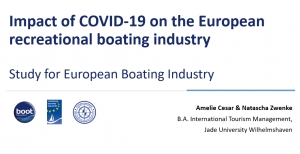
Brussels/Düsseldorf/Cologne, 29 April 2021 – The first-ever study by European Boating Industry, Bundesverband Wassersportwirtschaft e.V., and boot Düsseldorf offers a unique insight into how the recreational boating industry in Europe fared in 2020 given the COVID-19 pandemic. Presented at the International Breakfast Meeting on 20 April and now published, the study shows a mixed impact on the industry in 2020 with a positive outlook for the next years and some clear trends.
The study, led by two graduates of the Jade University Wilhelmshaven in Germany (Amelie Cesar & Natascha Zwenke) is the result of a unique cooperation between European Boating Industry, Bundesverband Wassersportwirtschaft e.V. and boot Düsseldorf. The study analyses the impact of the pandemic in 2020 on a number of key indicators and the outlook of the industry. It is based on the responses of companies within EBI’s membership that were surveyed in late 2020 following the end of the summer season, as well as interviews with experts among EBI’s full members.
The study shows a varied picture of the impact of COVID-19 and the various restrictions at national level for 2020, with some countries and some sub-sectors more impacted than others. Some markets however also did exceptionally well with revenues increasing. A clear picture emerges for 2021 and beyond, showing a positive outlook for companies. It also demonstrates the need for political support measures at national and European level.
Some key messages from the study:
- Small and medium-sized enterprises (SMEs): Over 96 % of companies that responded were SMEs, and almost half were micro-SMEs.
- Revenue: A third of companies indicated an increase while more than half recorded a drop in revenues. Companies with their main activity in tourism and production have been hit harder than companies in the distribution sector and service sectors.
- Employment: 23 % of companies had to lay off employees while 22% increased employment. The impact on employment may be more significant in the long-term.
- Future trends: The interest in boating is seen as increasing in the short- and the long-term. Companies increasingly focus on digitalisation and partly also on environmental sustainability. Investments had to however be postponed in 2020 given the pandemic.
- Government support: In all countries, governments supported companies in difficulty. Government support however remains necessary on a national and European level with a focus on financial support, effective legislation, and promotion.
- Industry outlook: The outlook for businesses in the boating industry is perceived as positive for 2021 with only 23% seeing it as poor.
The full results of the study and analysis are available for members of EBI, BVWW and the network of boot Düsseldorf. A limited version and executive summary can be downloaded here.
Commenting on the study Petros Michelidakis, boot Düsseldorf Project Director, said: “The result of this study is also essential for the further development of boot Düsseldorf. The international boating industry and the entire water sports have enormous potential. We will use this for boot Düsseldorf and continue to offer the water sports community a show that is unique worldwide and will be the reflection of the market. I am very pleased that we will already prove this at boot 2022, because the industry's interest in taking part and present to its audience again is very high.”
Karsten Stahlhut, Managing Director of BVWW commented “The study shows the great potential of the water sports industry. Together, we should do our utmost to always remain future-proof and innovative, also with regard to digitalisation and the upcoming technical transformation”
Philip Easthill, EBI Secretary-General, stated: “It is encouraging to see that our industry has been able to hold up well in 2020 and companies are positive for the future. This shows the resilience of our industry and hard work over the last year. Our industry is clearly very well positioned to take advantage of new consumer trends and benefit in the short- and long-term. Given the impact that the pandemic has nevertheless had, the study clearly shows the importance of effective policy at all levels of government to support recovery and help the industry return to growth in the next years.”
About boot Düsseldorf
boot Düsseldorf is the biggest boat and water sports trade fair in the world with almost 250,000 visitors and is the place where all of the industry meets every January. About 2,000 exhibitors are presenting their interesting innovations, attractive new developments and maritime equipment with the next edition taking place from 22 to 30 January 2022. The market will be coming to Düsseldorf to provide an exciting insight into the entire water sports world for the nine-day exhibition covering 220,000 square metres in 17 different halls. There is something for every water sports enthusiast, with the main focus on boats and yachts, motors and engine technology, equipment and accessories, services, canoes, kayaks, kitesurfing, rowing, diving, surfing, wakeboarding, windsurfing, SUP, fishing, maritime art, marinas, water sports facilities, beach resorts and chartering. All necessary information can be found on boot Düsseldorf’s website, boot.com.
Press contact: Tania Vellen, Phone: +49 211 4560 518, Email: This email address is being protected from spambots. You need JavaScript enabled to view it. and Cathrin Neitzel, Phone: +49 211 4560 589, Email: This email address is being protected from spambots. You need JavaScript enabled to view it.
About Bundesverband Wassersportwirtschaft e.V.
The German Leisure Marine Federation (Bundesverband Wassersportwirtschaft e.v.) has been the voice of the German water sports industry for over 50 years and represents the interests of the industry at national and international level. More information can be found on www.bvww.org
Press contact: This email address is being protected from spambots. You need JavaScript enabled to view it.
About European Boating Industry
European Boating Industry (EBI) represents the recreational boating industry in Europe. It encompasses all related sectors, such as boatbuilding, equipment manufacturing, marinas and service providers. The industry is a significant contributor to the European economy, representing 32,000 companies that employ over 280,000 people directly. The vast majority of the sector is made up of Small- and Medium-sized Enterprises (SMEs). More information on EBI’s website: europeanboatingindustry.eu.
Press contact: This email address is being protected from spambots. You need JavaScript enabled to view it.
 European Boating Industry (EBI) and the European Composites Industry Association (EuCIA), representing respectively the Recreational Boating and Composites industries at European level, have agreed on a new partnership. The aim is to jointly tackle the key challenges around circularity of composites used in the recreational boating industry and promote sustainable recycling solutions to the supply chain for end-of-life boats. Composites are the main material for manufacturing of recreational boats.
Following a common understanding of the importance of the circular economy and aiming to find solutions for end-of-life composites, European Boating Industry (EBI) and European Composites Industry Association (EuCIA) agreed a formal partnership. The aim will be to find common approaches to the key issues of dismantling, recycling, and the future of composites in the recreational boating industry.
The partnership will also follow policy developments at EU level, such as the European Green Deal, the Circular Economy Action Plan, and the Working Group on End-of-Life boats co-chaired by EBI and the European Commission Directorate-General for Maritime Affairs and Fisheries (DG MARE). Cooperation will also extend to other composite use industries and related industries, such as the wind energy and the transportation segment.
Composites are the main material used for making hulls, decks and large components in boat building, estimated that 95% of all boats will have composite parts. Given that composite boats have been built already for several decades, the number of boats reaching their end-of-life is expected to increase in the coming years. Use of composites by the recreational boating industry is however estimated to around 3% of the global composite market with infrastructure, transportation, and the wind energy the largest use sectors.
Concrete cooperation activities between EuCIA and EBI will include:
- Cooperation in the End-of-Life boats Working Group co-chaired by EBI and DG MARE
- Exchange of information on dismantling, recycling, new materials, Life Cycle Analysis, and cross-sectoral cooperation
- Joint advocacy, communication activities and cooperation on projects at EU level
Speaking for EuCIA, Managing Director Ben Drogt said “The recreational boating industry was one of the first segments that recognized the advantages of composites as light and durable material. Now that the first generation of composite boats get to the end of their first use, EuCIA is convinced that the partnership with EBI will create a boost to further develop sustainable solutions to re-use the composite materials of these boats”. With partnerships like this, also in other applications areas such as the wind energy segment, EuCIA will seek for synergy and supports the development of economically viable re-use and recycle processes for composites.
Commenting on the agreement, Secretary-General of EBI Philip Easthill said “We are delighted to be closely cooperating with EuCIA and take on this important challenge through the partnership. It is crucial that our industries work together to develop the circular approach to composites that is environmentally and economically sustainable. While we have the challenge of end-of-life composites in our industry, it is only a small amount of the overall composite. This makes finding common solutions with other industry even more important.”
-----------------
About European Boating Industry (EBI)
European Boating Industry (EBI) represents the recreational boating industry in Europe. It encompasses all related sectors, such as boatbuilding, equipment manufacturing, marinas and service providers. The industry is a significant contributor to the European economy, representing 32,000 companies that employ over 280,000 people directly. The vast majority of the sector is made up of Small- and Medium-sized Enterprises (SMEs). It is a key contributor to tourism and has a global trade perspective.
EBI is an established stakeholder at EU level, defending and promoting the interests of its members on key issues ranging from Single Market legislation to blue growth, tourism and trade policy.
Press enquiries
Email: This email address is being protected from spambots. You need JavaScript enabled to view it.
www.europeanboatingindustry.eu
About EuCIA
Headquartered in Brussels, the European Composites Industry Association (EuCIA) represents European national composite associations as well as industry-specific sector groups at EU level. With the support of its members EuCIA is actively contributing to building an economically and environmentally sustainable European composites industry. EuCIA closely monitors relevant standards and legislation, actively communicates the ways in which composites contribute to a more sustainable world, and promotes educational activities. Our initiatives aim to enable the healthy growth and continued competitiveness of more than 10,000 companies and an estimated 150,000 employees involved in composites manufacturing across Europe.
Press enquiries
Email This email address is being protected from spambots. You need JavaScript enabled to view it.
www.eucia.eu
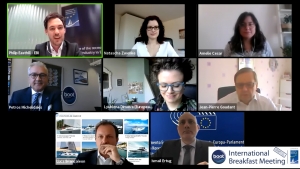
Brussels/Düsseldorf 20 April 2021 – The 2021 International Breakfast Meeting was held digitally on 20 April to great success. High-level panellists from business and politics, including European Commissioner Sinkevičius and a Member of the European Parliament, discussed the key issues for the boating industry, including the impact of COVID-19, the sector’s recovery, and trends in travel and tourism. It was a unique opportunity for the boating industry to come together in a highly relevant exchange.
The 6th edition of the International Breakfast Meeting (IBM), which was jointly organised by European Boating Industry (EBI) and boot Düsseldorf, was successfully held on 20 April. The event, which was held online for the first time, brought together high-level experts from the worlds of business and politics to discuss the impact of COVID-19 on the recreational boating industry, the industry’s recovery, and new trends and opportunities, under the title “A Corona reboot of tourism and recreation: What future for boating?”.
The event, which was moderated by EBI Secretary-General Philip Easthill and introduced by boot Düsseldorf Project Director Petros Michelidakis, included the participation through video message of European Commissioner for Environment, Oceans and Fisheries, Virginijus Sinkevičius. This was the first time a Commissioner participated in IBM, showing the increasingly prominent presence of the boating industry in EU policy-making. Commissioner Sinkevičius stated that “the recreational boating industry will have an essential role to play to help us build back better”, and he referred to the European Green Deal and to the forthcoming Sustainable Blue Economy Strategy as key policies to ensure the protection and cleanliness of marine areas.
Also coming from the sphere of EU policy-making, Member of the European Parliament Ismail Ertug shared with participants the latest developments in EU tourism policy. Mr Ertug, who is member of the European Parliament’s Transport and Tourism Committee, stated that the sector is facing four main challenges: the first one is about security and safety; the second one is about economic competitiveness among Member States which have different regulatory, administrative and tax burdens; the third one is about technology, where businesses have to keep up with globalisation and digitalisation; and the fourth one is the growing demand for customised experiences. “We are in the middle of the pandemic and last year was the worst one ever, but this is also a big chance for tourism policy. In the past it was national competence of Member States, but now this is maybe a chance for harmonisation at the EU level.”
Next, Amelie Cesar and Natascha Zwenke, graduates from the Jade University of Applied Sciences, presented to attendees the study they conducted for EBI on the impact of COVID-19 on the boating industry. This study will be officially published on 27 April. Moreover, Lyublena Dimova, Research Manager at the European Travel Commission, gave insights into post-COVID-19 trends in the wider travel and tourism sector. Clearly visible are an increasing optimism among Europeans to travel, a preference for domestic and intra-regional destinations, as well as coastal getaways being extremely appealing for Western and Central Europeans. Luca Brancaleon, Deputy Director Manager of Groupe Beneteau, talked about the future direction of the industry. Finally, EBI President Jean-Pierre Goudant gave a closing speech.
Petros Michelidakis, boot Düsseldorf Project Director, said: “IBM 2021 provided a formidable opportunity to come together as an industry and look back on this past year, taking stock of the impact that COVID-19 has had on the sector. Although this year’s boot Düsseldorf had to be cancelled, we have put together an extremely successful online IBM, which has been accessible to new participants. I would like to extend my sincere gratitude to all speakers for taking part and to all participants for making of this event a great success.”
Jean-Pierre Goudant, EBI President, commented: “It was a great event, and we were delighted with such a strong presence from the EU institutions, as well as to hear the latest market trends. Boating and the nautical tourism industry are well positioned to take advantage of the new opportunities in tourism and recreation. The advocacy work that we lead as EBI at EU level will help to drive this forward and support the industry. We very much thank our co-organisers, boot Düsseldorf and Petros Michelidakis, for their support in the event and in these challenging times. We are excited to return to boot Düsseldorf 2022 and hold an in-person International Breakfast Meeting on 25 January 2022.”
The event was attended by 220 people. The livestream can be found here. Further information on IBM is available here.
About boot Düsseldorf
boot Düsseldorf is the biggest boat and water sports trade fair in the world with almost 250,000 visitors and is the place where all of the industry meets every January. About 2,000 exhibitors are presenting their interesting innovations, attractive new developments and maritime equipment with the next edition taking place from 22 to 30 January 2022. The market will be coming to Düsseldorf to provide an exciting insight into the entire water sports world for the nine-day exhibition covering 220,000 square metres in 17 different halls. There is something for every water sports enthusiast, with the main focus on boats and yachts, motors and engine technology, equipment and accessories, services, canoes, kayaks, kitesurfing, rowing, diving, surfing, wakeboarding, windsurfing, SUP, fishing, maritime art, marinas, water sports facilities, beach resorts and chartering. All necessary information can be found on boot Düsseldorf’s website, boot.com.
Press contact: Tania Vellen, Phone: +49 211 4560 518, Email: This email address is being protected from spambots. You need JavaScript enabled to view it. and Cathrin Neitzel, Phone: +49 211 4560 589, Email: This email address is being protected from spambots. You need JavaScript enabled to view it.
About European Boating Industry
European Boating Industry (EBI) represents the recreational boating industry in Europe. It encompasses all related sectors, such as boatbuilding, equipment manufacturing, marinas and service providers. The industry is a significant contributor to the European economy, representing 32,000 companies that employ over 280,000 people directly. The vast majority of the sector is made up of Small- and Medium-sized Enterprises (SMEs). More information on EBI’s website: europeanboatingindustry.eu.
Press contact: This email address is being protected from spambots. You need JavaScript enabled to view it.
 English
 Български
 Hrvatski
 Čeština
 Dansk
Dansk Nederlands
 Eesti
Eesti Suomi
Suomi Français
 Deutsch
 Ελληνικά
 Magyar
 Gaelige
 Italiano
 Latviešu valoda
 Lietuvių kalba
 Maltese
 Norsk bokmål
 Polski
 Português
 Română
 Русский
 Slovenščina
 Español
 Svenska