

- Home

- Newsroom
- Press releases
- Super User

Super User
In April, the Forest Stewardship Council (FSC) was invited to EBI Executive Committee to present their latest initiative to prevent deforestation in cooperation with the boating and yachting sector: Yachting for Forests.
The aim of the initiative is to encourage the boating industry to use sustainabily sourced wood for its different needs, focusing on teak and other timber. FSC sees the boating industry in a unique position, as it uses large volumes of the world´s finest hardwood timber species, making it a key player in the advancement and support of responsible forest sourcing. The choice of the sector will be crucial to set the path towards forest development.
EBI members, and manufacturers in particular, can have access to the FSC inspiration magazine and the procurement policy implementation guide. For this, please contact the EBI Office.
More information about Yachting for Forests and FSC can be found here.
The study, initiated by boot Düsseldorf, developed by European Boating Industry, supported by ADAC and conducted by Sea Teach SL, gathers relevant data on the needs of boaters and can be a useful guide for manufacturers, giving them a better understanding of the future trends of the industry and the views of consumers in particular.
The study shows a clear support for sustainability and the use of alternative drives and fuels. However, consumers remain critical towards paying significantly higher prices or compromising on range and safety. A clear focus on decarbonisation technology is not yet evident at this stage. The industry must continue to develop with foresight and react to new demands from politics and, as a result, to the expectations of customers.
The official press release, is available here. An Executive Summary of the study is available on the business visitor site of boot.com.
HELCOM, or the Helsinki Commission, is an intergovernmental organization that works to protect and conserve the marine environment of the Baltic Sea region. Its members include the nine coastal states and the European Union.
HELCOM is relevant for the recreational boating sector as it provides joint policy approaches, guidance and recommendations on sustainable practices for boating activities in the Baltic Sea. For example, HELCOM has developed guidelines on the disposal of sewage from boats and the issue of end-of-life recreational boats, which aim to prevent pollution and protect the marine environment. Additionally, HELCOM works to monitor and reduce harmful substances in the Baltic Sea, which can impact the health of boaters and marine life. Overall, HELCOM plays an essential role in promoting sustainable boating practices, protecting the marine environment, and providing resources for recreational boaters in the Baltic Sea region.
EBI is now an observer member of the HELCOM Commission and its various Working Groups in which the recreational boating industry is now represented. This follows EBI’s strategy on being more involved in European issues that are not directly being dealt with by the EU institutions. EBI is already an observer member of the OSPAR Convention for the North-East Atlantic and has recently applied for the same status within the Barcelona Convention for the Mediterranean Sea.
The European Commission sent reasoned opinions to Bulgaria (INFR(2022)2025), Greece (INFR(2021)2226), Italy (INFR(2021)2223), Cyprus (INFR(2021)2227) and Romania (INFR(2021)2224) on failure to ensure proper implementation of Directive (EU) 2014/89 establishing a framework for maritime spatial planning.
The EU's Maritime Spatial Planning Directive (MSP) is relevant for the recreational boating sector as it establishes a framework for the sustainable use of marine resources and the spatial planning of maritime activities.
The MSP directive requires member states to develop national maritime spatial plans that integrate various maritime activities, including recreational boating, to ensure sustainable and coordinated use of marine resources. Moreover, the MSP directive encourages member states to involve stakeholders, such as the recreational boating sector, in the planning process to ensure that their interests are considered. This can provide opportunities for the recreational boating sector to voice their needs and concerns and contribute to the development of plans that consider their needs and provide suitable and accessible areas for boating activities.
The Directive requires coastal EU Member States to draw up maritime spatial plans no later than 31 March 2021, and to submit copies of the plans to the Commission and other Member States concerned within three months of their publication. However, Bulgaria, Greece, Italy, Cyprus and Romania have s not yet established their maritime spatial plans. Therefore, the Commission has decided to send them reasoned opinions. They now have two months to respond and take the necessary measures to address the shortcomings identified. Otherwise, the Commission may decide to refer the case to the Court of Justice of the European Union.
The Council of the European Union has adopted the general product safety regulation (GPSR), which reinforces the safety rules for products sold both offline and online. The regulation will reinforce market surveillance for unsafe products and consumer rights for anyone who has been sold an unsafe product. It should be noted that the GSPR only applies for products where there is no specific legislation, meaning companies in the recreational boating industry (i.e suppliers) will have to comply the GSPR in products such as for Recreational Craft or Personal Protective Equipment.
The new approved GPSR makes it easier for consumers to repair, return or replace unsafe products:
- online marketplaces will have to co-operate with market surveillance authorities and must establish a single point of contact in charge of product safety.
- market surveillance authorities will be able to order online marketplaces to remove dangerous products from their platforms or to disable their access.
- a single market surveillance regime will apply to all products.
- if a product has proven to be unsafe, economic operators must immediately adopt corrective measures and inform market surveillance authorities and consumers.
- consumers will be entitled to choose either to have it repaired or replaced or to be refunded if a product has to be recalled.
- economic operators should have a responsible for products sold online and offline (independently of the product’s origin), who will ensure the availability of technical documentation, instructions, and safety information
Following the approval by the Council of the EU and European Parliament, the legislative act has been adopted. Member States will have 18 months to apply the new rules on general product safety.
The approved general product safety regulation can be found here.
The European Parliament approved a new law to fight climate change and biodiversity loss. This decision will ensure that products sold in the EU have not led to deforestation, making companies comply with a so-called “due diligence” statement confirming that the product does not come from deforested land or has led to forest degradation.
While there is not a ban on any product or country, the European Commission issued a list with the products affected by this new law, including wood and many derived products. The list can be found here.
Boatbuilders are among those who will need to comply with the additional due diligence statement, proving that the timber used by them complies with the new regulation. This may include keeping more detailed records of timber sourcing and supply chain. However, this new regulation provides a new opportunity for companies of the boating industry to demonstrate their commitment and support towards sustainability.
To read more about this new law, click here.
19 April, 10:00 CEST 2nd Executive Committee (Online, Zoom)
20 April, 11:00 CEST EBI Webinar - Understanding and implementing LCA in the Boating Industry (Online, Zoom)
24 – 25 May European Maritime Day (Brest, France)
20 – 21 June General Assembly (Jeanneau - Les Herbiers, France)
20 June, Afternoon 3rd Council meeting (Les Herbiers, France)
21 June, Morning 2nd General Assembly (Les Herbiers, France)
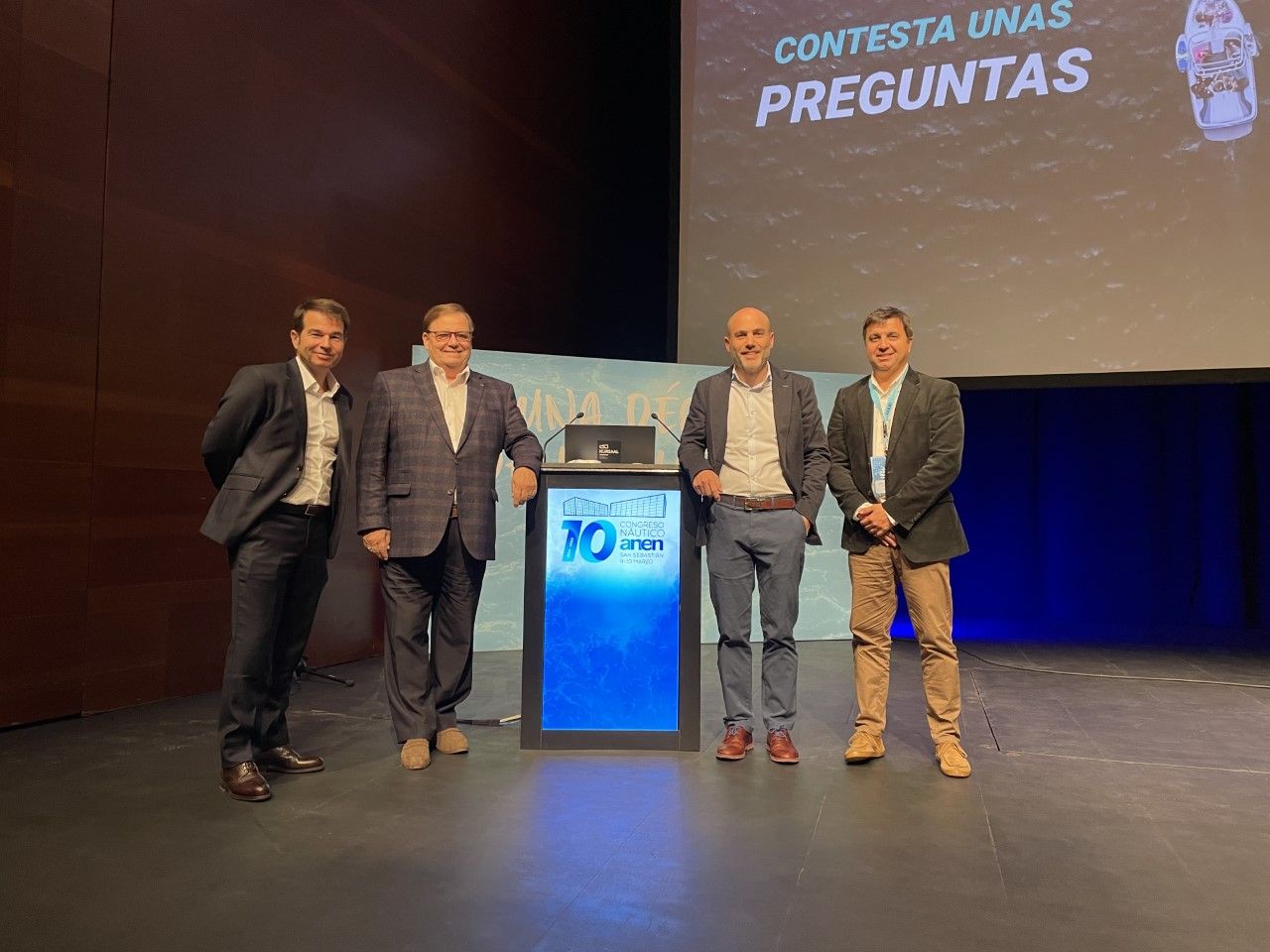
ANEN, the association representing nautical companies in Spain, held its 10th Nautical Congress on 9 and 10 March.
The Congress, which took place in San Sebastian, hosted several industry experts who offered the keys to issues such as sustainability within the nautical sector, the economic balance of the industry both at Spanish and international level, the creation of the Codification Commission of Recreational Boating in Spain and the specialisation of workers through training.
The 10th ANEN Congress registered a record attendance, including Jean-Pierre Goudant, President of EBI, who participated in the interesting discussions around the Congress.
You can learn more about the 10th Nautical Congress here.
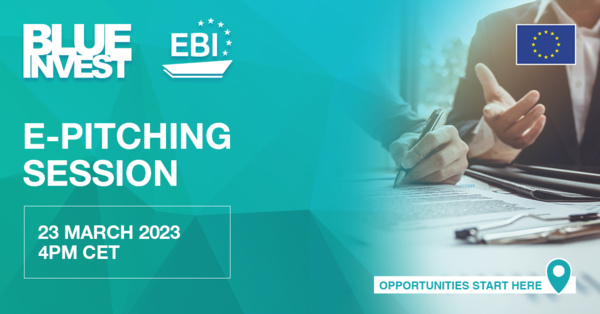
March was a great month for the blue economy, with two events organised by the BlueInvest Initiative, one of them in collaboration with EBI.
BlueInvest Day took place on 9 March, bringing together founders, investors and stakeholders to discuss scaling up finance for a sustainable blue economy #MadeInEurope. EBI, attended as the European stakeholder representing and connecting boating companies and EU institutions.
As main counterpart for the European Commission in the recreational boating industry, EBI was delighted to see such a positive take in of its latest activities from the BlueInvest Initiative and the recognition of the efforts and progress the nautical sector is doing on innovation and sustainability. Some fantastic companies from the sector were nominated, many of which participated in the blue innovation dock earlier this year including nlcomp, BlueNav or this year´s blue innovation dock winner, Seares.
Two weeks later, EBI organised together with BlueInvest the second BlueInvest e-pitching session, focused on the recreational boating sector. This event featured 5 innovative companies from the sector: 13 Mari (Bulgaria), Boatsandgo (Italy), Sylents (Germany), Toqua (Belgium) and Vision Anchor (Slovenia).
The participants had the opportunity to pitch their companies and ideas to several investors who in turn could get a better understanding of the participants and with them, of the progresses the nautical industry is doing on innovation and sustainability.
The recording of the session is available here.
You can learn more about the BlueInvest initiative here.
 English
 Български
 Hrvatski
 Čeština
 Dansk
Dansk Nederlands
 Eesti
Eesti Suomi
Suomi Français
 Deutsch
 Ελληνικά
 Magyar
 Gaelige
 Italiano
 Latviešu valoda
 Lietuvių kalba
 Maltese
 Norsk bokmål
 Polski
 Português
 Română
 Русский
 Slovenščina
 Español
 Svenska